


Accuphase's Flagship Class AB Stereo Power Amplifier
The P-7500 is a Class AB, solid-state stereo power amplifier and the top of Accuphase's Class AB power amp line. It is built for big, demanding speakers: ten pairs of bipolar output transistors per channel deliver 300 W into 8 ohms, 600 W into 4 ohms and 900 W into 2 ohms (4 and 2 ohms: music signals).
It is also quiet: its guaranteed 130 dB S/N ratio is the highest of Accuphase's Class AB power amps (the P-4600 and the P-7300 it replaced are rated 125 dB), and its damping factor is guaranteed at 1,000. A four-step gain selector lets you match it to your preamp and speakers, and two units can be bridged as mono amplifiers of 1,200 W each into 8 ohms (music signals).
TTVJ is an authorized Accuphase dealer. You're buying through the brand's own dealer network, with advice from someone who has set up these amplifiers in real listening rooms.
Is It Right for You?
A Great Fit If You Want
- To drive large or low-impedance speakers: rated 600 W into 4 ohms and 900 W into 2 ohms (music signals).
- A silent background with sensitive speakers: 130 dB S/N at maximum gain, 135 dB with the gain at −12 dB.
- A path to more power: add a second P-7500 later and bridge the pair, or run them in dual mono for bi-amping.
- To bi-amp from an Accuphase integrated: its 28 dB maximum gain matches the power section of Accuphase's integrated amplifiers (see Pairing).
Consider Something Else If You Need
- Class A operation: Accuphase's Class A power amps are the A-48S (50 W/ch), the A-80 (65 W/ch) and the A-300 (125 W, a mono amp, so two are needed for stereo).
- A smaller, lighter Class AB amp: the P-4600 gives 150 W/ch into 8 ohms at 30.0 kg and 190 mm high (see the comparison below).
- One box instead of separates: Accuphase's most powerful integrated, the E-6000, gives 260 W/ch into 8 ohms.
Design
Ten-Pair Output Stage
Each channel's output stage uses ten parallel push-pull pairs of bipolar power transistors in Class AB, built to deliver large current regardless of the speaker's impedance swings.
Balanced remote sensing takes feedback for both signal and ground right at the speaker terminals, and a MOS-FET switch (1.6 mΩ on-resistance, 20% lower than the P-7300's) replaces mechanical relays in the speaker protection circuit. Accuphase credits both with improving the damping factor, which is guaranteed at 1,000.
Low-Noise Input Stage
The input stage is a balanced instrumentation amplifier. Accuphase gives it most of the gain (12.6×, or 22 dB) and leaves only 2× (6 dB) to the power stage, which keeps noise low. MCS+ (Multiple Circuit Summing-up) runs the voltage amplification stage as two parallel circuits, which in theory cuts noise by about 30%, and current-feedback topology keeps frequency response nearly unchanged as you switch gain.
Measured output noise is 16 µV, 11% lower than the 18 µV of the P-7300 it replaced, and guaranteed S/N rises from 125 to 130 dB.
Power Supply and Protection
A large high-efficiency toroidal transformer feeds two custom 60,000 µF filter capacitors. Inside the single chassis, the left and right power amplifiers are built as separate mono-block units.
A new photo-coupler-isolated protection circuit detects speaker short circuits, and temperature sensors on the heat sinks watch for overheating. Protection also responds to a signal with a large DC component. When it operates, the outputs are cut and the meter lighting flashes.
Controls and Meters
Two large analog needle power meters use a logarithmic scale with a −50 dB mark for low-level listening, peak hold (3 seconds or infinite) and a switch to turn their lighting off.
The front panel has the LINE/BALANCED input selector and the gain selector. The rear panel has the operation selector and a polarity selector for the balanced input.
Connect It
Inputs, Outputs and Operating Modes
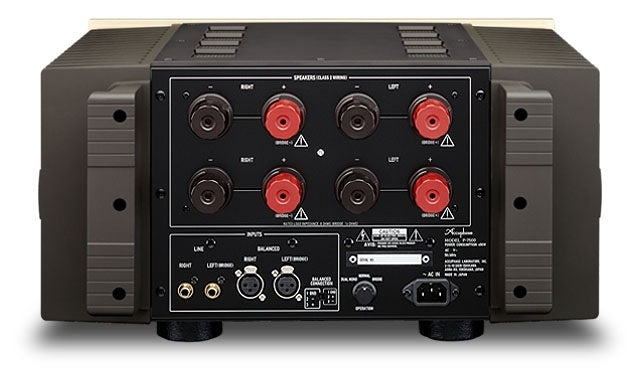
| Inputs | 1 balanced (XLR, 40 kΩ) and 1 unbalanced (RCA, 20 kΩ), chosen with the front-panel input selector; balanced polarity selectable |
|---|---|
| Speaker outputs | Two pairs of large terminals per channel, connected internally (same signal), for bi-wiring. They take Y-lugs from 6.3 to 19 mm or 4 mm banana plugs. |
| Gain selector | MAX (28 dB), −3 dB (25 dB), −6 dB (22 dB), −12 dB (16 dB) |
| Stereo | 300 W/ch into 8 Ω; 600 W/ch into 4 Ω; 900 W/ch into 2 Ω (4 and 2 Ω music signals). Loads down to 2 Ω. |
| Bridged (two units, one per channel) | 1,200 W into 8 Ω; 1,800 W into 4 Ω (music signals). Loads of 8–16 Ω, or 4–16 Ω with music signals. Needs 3.90 V input for rated output. |
| Dual mono bi-amping (two units) | Each P-7500 drives one speaker, with one channel on the woofer section and the other on the tweeter section. Set both units to the same gain. The speakers need separate low and high inputs. |
Setup Notes
- Placement: it weighs 49.0 kg (58 kg boxed) and needs 515 mm (20.3 in) of depth and 238 mm (9.4 in) of height. Plan on two people to lift it, and leave room for ventilation.
- Balanced input: the input selector ships set to LINE. Switch it to BALANCED if you're using the XLR input.
- Two units: for bridged or dual mono use, set both amplifiers to the same gain.
Pairing
With a Preamplifier
At maximum gain the P-7500 reaches full rated output with 1.95 V at its input (3.90 V when bridged). Accuphase's current preamplifiers, the C-3900S, C-2900 and C-2300, have a rated output of 2 V.
With high-efficiency speakers, try a lower gain setting so you use more of the preamp's volume range. The amp's own guaranteed S/N rises from 130 to 135 dB at −12 dB.
With an Accuphase Integrated
Accuphase's integrated amplifiers can bi-amp through their pre outputs, and they specify equal gain for both amplifiers. The power sections of the E-800S, E-700, E-4000, E-3000 and the earlier E-5000 all run at 28 dB, the same as the P-7500 at its MAX setting.
Feed the P-7500 from the integrated's pre out and let it drive the speakers' low section. The speakers need separate low and high inputs with a built-in crossover.
Reviews
FIDELITY: "Perfection"
"…amplify signals without adding even a hint of its own signature."
Barnbeck, listening through an Accuphase C-2300 preamp into Wilson Audio Sasha V speakers, found the P-7500 neutral and uncolored, with a calm grandeur he struggled to put into words. He found its dynamics and headroom left nothing to be desired, though it never dazzles with thunderous dynamic effects. His caveats: its tonal character comes mostly from the preamp you pair it with, and the gain selector made no audible difference in his system.
Read the review: FIDELITY
P-7500 vs. P-4600
Accuphase's Two Class AB Stereo Power Amps
| P-7500 | P-4600 | |
|---|---|---|
| Type | Class AB stereo | Class AB stereo |
| Output stage | 10-pair bipolar push-pull | 6-pair bipolar push-pull |
| Power, 8 Ω | 300 W/ch | 150 W/ch |
| Power, 4 Ω (music) | 600 W/ch | 300 W/ch |
| Power, 2 Ω (music) | 900 W/ch | 450 W/ch |
| Bridged, 8 / 4 Ω (music) | 1,200 / 1,800 W | 600 / 900 W |
| Damping factor | 1,000 | 800 |
| S/N (max gain) | 130 dB | 125 dB |
| Gain selector | 4 steps | 4 steps |
| Size (W × H × D) | 465 × 238 × 515 mm | 465 × 190 × 427 mm |
| Weight | 49.0 kg (108 lb) | 30.0 kg (66.2 lb) |
| Idle power draw | 142 W | 94 W |
Choose the P-7500 If You
- Need the most power: 300 vs 150 W into 8 ohms, 900 vs 450 W into 2 ohms.
- Want the quietest background: 130 vs 125 dB S/N.
- Want a higher damping factor: 1,000 vs 800.
Choose the P-4600 If You
- Have a low or shallow shelf: 190 mm high and 427 mm deep, vs 238 and 515 mm.
- Need a lighter amp to place: 30.0 vs 49.0 kg.
- Want less heat and lower idle draw: 94 vs 142 W.
Not Sure Which to Choose?
Deciding between the P-7500 and the P-4600, or how to match one to your preamp or integrated? Todd can talk it through with you.
Specifications
Accuphase P-7500 Guaranteed Specifications
| Type | Class AB solid-state stereo power amplifier |
|---|---|
| Rated output (20 Hz–20 kHz, 0.05% THD) | Stereo: 300 W/ch into 8 Ω; 600 W/ch into 4 Ω*; 900 W/ch into 2 Ω* Bridged: 1,200 W into 8 Ω*; 1,800 W into 4 Ω* *Music signals only |
| Output stage | Ten-fold parallel push-pull bipolar power transistors, Class AB |
| Total harmonic distortion (20 Hz–20 kHz) | Stereo: 0.05% (2 Ω); 0.03% (4–16 Ω) Bridged: 0.05% (4–16 Ω) |
| Intermodulation distortion | 0.01% |
| Frequency response | At rated output: 20 Hz–20 kHz, +0/−0.2 dB At 1 W: 0.5 Hz–160 kHz, +0/−3.0 dB |
| Damping factor | 1,000 or more (stereo) |
| Gain | 28 dB (MAX), 25 dB (−3 dB), 22 dB (−6 dB), 16 dB (−12 dB) |
| Input sensitivity | Stereo: 1.95 V at rated output; 0.11 V at 1 W Bridged: 3.90 V at rated output; 0.11 V at 1 W |
| Input impedance | Balanced 40 kΩ; RCA 20 kΩ |
| S/N ratio (A-weighted, input shorted) | 130 dB (gain MAX); 135 dB (gain −12 dB) |
| Power meters | Analog, logarithmic, −∞ to +3 dB; peak hold 3 s or infinite; illumination off switch |
| Inputs | 1 balanced (XLR), 1 unbalanced (RCA) |
| Outputs | Two pairs of speaker terminals per channel (same signal) |
| Operating modes | Stereo, dual mono, bridged |
| Power requirements | 120 V, 220 V or 230 V AC, 50/60 Hz, as marked on the rear panel |
| Power consumption | 142 W idle; 450 W (IEC 62368-1); 0.3 W standby |
| Dimensions (W × H × D) | 465 × 238 × 515 mm (18.3 × 9.4 × 20.3 in) |
| Weight | 49.0 kg (108 lb) net; 58 kg (128 lb) in carton |
| In the box | AC power cord |
Order Your Accuphase P-7500
As an authorized Accuphase dealer, TTVJ handles your order personally, from confirming the configuration to delivery. Reach Todd by phone or message to:
- Confirm current pricing and availability
- Discuss a trade-in of your current amplifier
- Ask about financing and shipping