


An FM Stereo Tuner Built Around DDS and DSP
The T-1300 is Accuphase's FM stereo tuner and the latest in a line that began with the T-100 in 1973. It is a DDS FM stereo tuner with DSP processing: an analog, double-tuned front end handles the radio signal, and from the intermediate frequency (IF) stage onward the processing is digital. That includes the variable-bandwidth IF filter, multipath reduction, FM demodulation and stereo decoding. The local oscillator uses Direct Digital Synthesis (DDS) rather than the PLL most tuners use, avoiding the frequency-modulation components that degrade S/N.
It replaces the T-1200 with better sensitivity and lower noise. Mono usable sensitivity improves from 9 to 5 dBμV, so weaker stations become listenable, and S/N rises by 2 dB, to 94 dB in mono and 78 dB in stereo. Six IF bandwidths and multipath reduction deal with crowded dials and reflected signals, and each of the 20 station memories also remembers its own settings. A large tuning knob gives you manual tuning, and balanced, line and coaxial digital outputs connect it to your system.
TTVJ is an authorized Accuphase dealer. You're buying through the brand's own dealer network, with advice from someone who has set up these components in real listening rooms.
Getting the Best Reception
Reception Controls
| IF bandwidth | 50, 75, 100, 150, 250 or 500 kHz. A linear-phase digital filter; narrow it when a neighboring station interferes. |
|---|---|
| Multipath reduction (MPR) | An adaptive filter that detects multipath and reduces the distortion and noise caused by signals reflected off buildings and terrain. |
| Mode | Stereo; Blend, which mixes the left and right channels to reduce noise, especially in the upper range; or Mono. |
| LOCAL attenuator | Reduces the antenna input when a very strong station overloads the front end. |
| Meter | Switches between signal strength and multipath. |
| Muting | Silences the noise between stations while tuning. |
Your Antenna
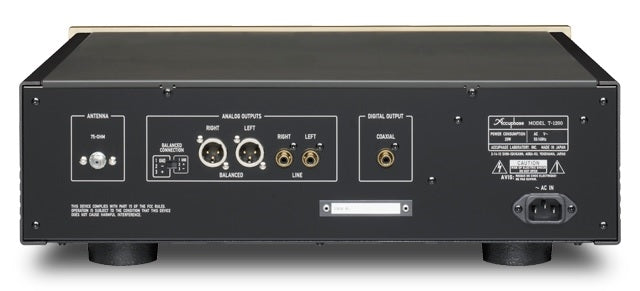
An FM antenna is required. It connects through a 75 Ω coaxial F-type input. If your building uses a shared antenna system, check that it carries FM. Ask Todd which antenna suits your location.
Tuning
The large tuning knob uses Accuphase's pulse tuning system, combining a manual-tuning feel with digital precision, with confirmation beeps as you tune. Twenty station memories give quick access to your favorites. The US version tunes 87.5 to 108.0 MHz.
Connecting It
Outputs and Remote
| Balanced (XLR) | 1.0 V, 50 Ω, with a polarity selector (pin 3 hot as shipped, or pin 2) |
|---|---|
| Line (RCA) | 1.0 V, 50 Ω |
| Coaxial digital | 48 kHz/24-bit (IEC 60958/AES-3), taken before D/A conversion. Feed an external DAC, such as Accuphase's DC-1000, the coaxial input of a DP-570S or DP-770, the DG-78 voicing equalizer, or the optional DAC-60 board in an Accuphase integrated amplifier. |
| Remote | The supplied RC-440 also operates Accuphase preamplifiers and integrated amplifiers. |
Is It Right for You?
A Great Fit If You Want
- To receive weak stations: 5 dBμV mono usable sensitivity and 9 dBμV for 50 dB quieting.
- Control over difficult reception: six IF bandwidths, multipath reduction and Blend, saved per station.
- A balanced connection: XLR output with polarity selection.
- To use your own DAC: a coaxial digital output.
- A matching Accuphase system: its remote also operates Accuphase preamplifiers and integrated amplifiers.
Consider Something Else If You Need
- AM reception: the T-1300 is an FM-only stereo tuner.
- Internet radio or streaming: it has no network connection; use a separate streamer feeding a DAC such as the DC-1000.
What's New Over the T-1200
Better Sensitivity and Lower Noise
| T-1300 | T-1200 | |
|---|---|---|
| Mono usable sensitivity | 5 dBμV | 9 dBμV |
| Mono 50 dB quieting | 9 dBμV | 12 dBμV |
| S/N, mono | 94 dB | 92 dB |
| S/N, stereo | 78 dB | 76 dB |
| Frequency response | 10–15,000 Hz, +0/−1.0 dB | 10–15,000 Hz, +0/−2.0 dB |
Figures are Accuphase's guaranteed specifications. The T-1300 also has a redesigned front panel, with the meter and indicators made easier to read and gold rings around the tuning knob, and a newly developed remote. The T-1200 is no longer in production.
Design
Front End
The only analog stage ahead of the outputs. Double-tuned circuits before and after the RF amplifier and two-stage double-balanced mixers handle strong interfering signals, with automatic gain control, double superheterodyne conversion and space-wound coils.
DDS and DSP
The DDS local oscillator avoids the frequency-modulation components that degrade S/N. A 40-bit floating-point Analog Devices DSP runs the IF filter, MPR and digital FM demodulator, and a second TI DSP runs DS-DC stereo demodulation: direct synthesis of the pilot tone plus two-stage crosstalk cancellation, for high stereo separation.
Conversion and Layout
The MDS D/A converter runs two AKM AK4490REQ converters in parallel per channel, feeding Direct Balanced Filter output circuits. The analog and digital sections are physically separated, with grounding designed to keep them from interfering with each other.
Specifications
Accuphase T-1300 Specifications
| Type | DDS FM stereo tuner with DSP processing from the IF stage on |
|---|---|
| Reception range | 87.5–108.0 MHz (tuning step depends on the country version) |
| Mono sensitivity | Usable 5 dBμV; 50 dB quieting 9 dBμV |
| Stereo sensitivity | 40 dB quieting 18 dBμV; 50 dB quieting 30 dBμV |
| S/N (85 dBμV input, A-weighted) | Mono 94 dB; stereo 78 dB |
| Total harmonic distortion (±75 kHz deviation) | Mono 0.02%; stereo 0.04% (20 Hz, 1 kHz, 10 kHz) |
| Frequency response | 10–15,000 Hz, +0/−1.0 dB (mono and stereo) |
| Stereo separation | 65 dB (100 Hz, 1 kHz); 50 dB (10 kHz) |
| Stereo trigger level | 9 dBμV |
| Alternate-channel selectivity (250 kHz IF bandwidth) | 50 dB at ±300 kHz |
| Capture ratio | 1.5 dB |
| Rejection | RF intermodulation 80 dB; spurious response 120 dB; image 100 dB; AM suppression 80 dB; subcarrier suppression 70 dB |
| IF bandwidth | 50, 75, 100, 150, 250, 500 kHz |
| Local oscillator | DDS (Direct Digital Synthesis) |
| Demodulation | Digital FM demodulator; DS-DC stereo demodulator |
| D/A converter | MDS, AKM AK4490REQ, 2 in parallel per channel |
| Antenna input | 75 Ω coaxial, F-type |
| Analog outputs | 1 balanced (XLR), 1 line (RCA); 1.0 V (±75 kHz deviation), 50 Ω |
| Digital output | Coaxial, 75 Ω; IEC 60958/AES-3; 48 kHz/24-bit |
| Station memories | 20, each storing MUTE, MODE, LOCAL, MPR and BANDWIDTH settings |
| Power requirements | 120 V, 220 V or 230 V AC, as marked on the rear panel; 230 V version has an eco mode that switches off after 120 minutes |
| Power consumption | 20 W |
| Dimensions (W × H × D) | 465 × 151 × 406 mm (18.3 × 5.96 × 16.0 in) |
| Weight | 13.1 kg (28.9 lb) net; 19 kg (42 lb) in carton |
| In the box | RC-440 remote control; AL-10 audio cable (1 m); AC power cord (2 m) |
Order Your Accuphase T-1300
As an authorized Accuphase dealer, TTVJ handles your order personally, from confirming the configuration to delivery. Reach Todd by phone or message to:
- Confirm current pricing and availability
- Discuss a trade-in of your current tuner
- Ask about financing and shipping