


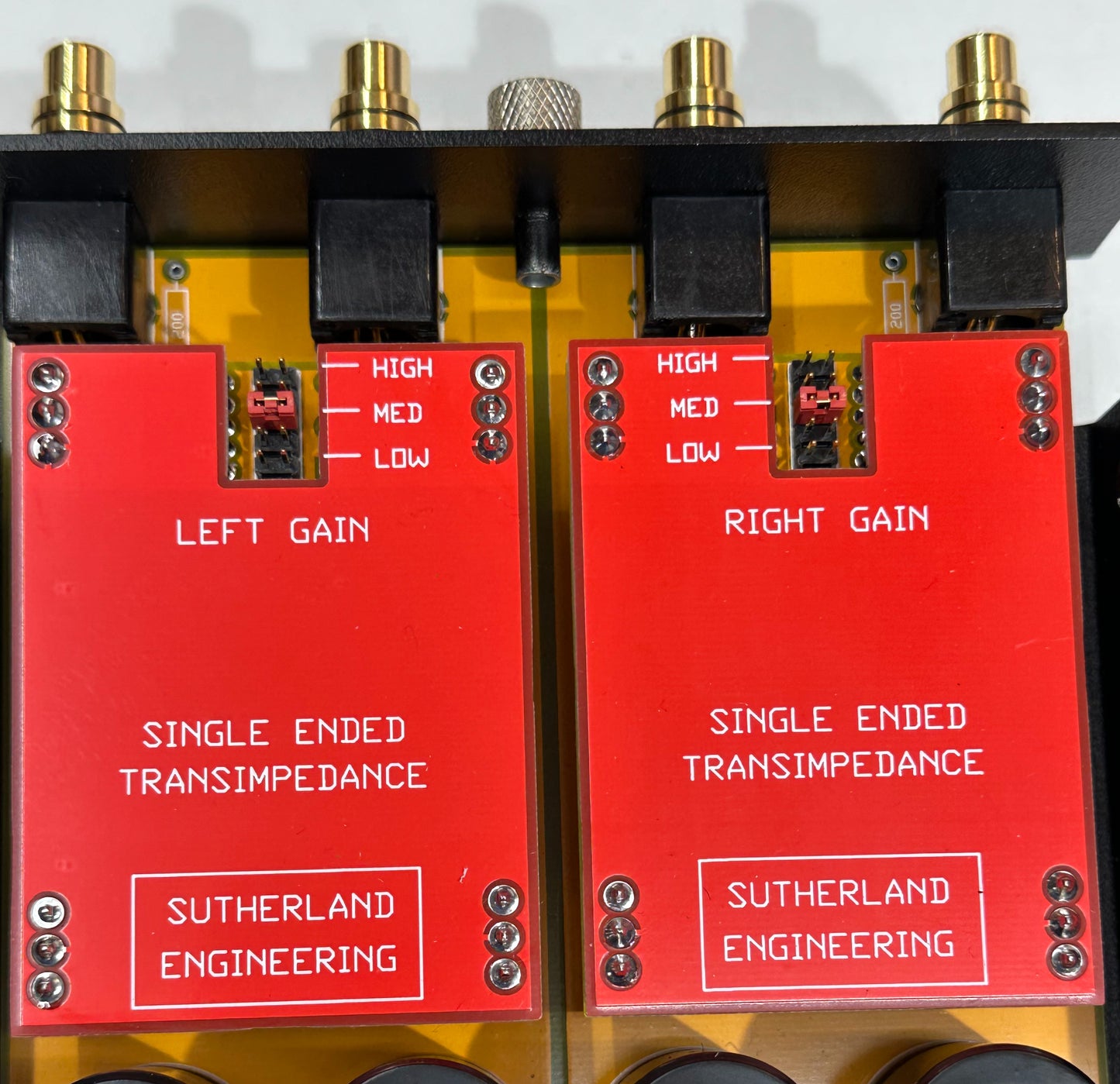
What is a SUTZ and who needs it?
The Sutherland SUTZ is a very special analog product that uses transimpedance to raise the output of your low-output, low-impedance moving coil cartridge to the level of a moving magnet cartridge.
SUTZ stands for Step-Up Transimpedance (Z being the symbol of impedance), and is based on the first gain stage of the flagship Sutherland Dos Locos transimpedance phonostage and shares the same chassis as the Little Loco Mk2.
Why not just use a traditional
step-up transformer (SUT)?
At Sutherland we have great respect for people who use SUTs, but recognize that it’s extremely expensive and time-consuming to find the perfect match between cartridge and SUT that this technology demands.
The SUTZ offers step-up transformer functionality but with the benefits of an active transimpedance gain stage like that of the Dos Locos. You just need a low-output moving coil cartridge with a low (<20 ohm) impedance. Most MC cartridges are well below this number.
Do you have a MM phonostage that you know and love, but want to move up to a MC cartridge? Put the SUTZ in between your table and phonostage to get all the benefits of a low-output MC cartridge (making sure it’s also low-Z), while keeping your beloved MM phonostage.
Do you have a low-output MC cartridge that you know and love, a vacuum tube MM/MC phonostage, and want to reduce tube noise? By putting a SUTZ between your table and the phonostage, you can now switch from using the phonostage’s MC input to using the MM input, This lower gain pathway gives reduced tube noise.
Technical Specs & Notes
CARTRIDGE COMPATABILITY
Use only low output MC, less than 20 Ohms internal resistance. Not MM, nor high output MC.
GAIN
Internally adjustable to HIGH, MED, or LOW. Transimpedance gain cannot be expressed in dB. There is plenty of gain for very low-output MC cartridges. Even with the lowest output MC, background noise vanishes.
Power Requirements:
120 VAC
240 VAC (Special Order)
Dimensions (WHD): 17″ x 2 1/2″ x 13″
Weight: 15 lb.
Price: $4300
What is Transimpedance Amplification?
A transimpedance phono stage is a moving‑coil phono preamp that works as a current‑to‑voltage converter: it takes the cartridge’s output current and converts it directly into a voltage, with gain set by a feedback resistor (the “transimpedance”), rather than amplifying the cartridge as a voltage source into a load.
Core definition
In circuit terms, it is a transimpedance amplifier (TIA) optimized for MC cartridges: an op‑amp (or discrete equivalent) with a large feedback resistor that produces an output Vout≈Iin×RfVout≈Iin×Rf.
The cartridge “sees” a virtual short at the input (very low input impedance), so its current is determined almost entirely by groove modulation and its own coil resistance, not by an external load resistor.
How that differs from voltage-mode phono
Conventional phono stages are voltage amplifiers: the cartridge drives some load impedance (often 100 Ω or more for MC) and the stage multiplies the resulting voltage.
A transimpedance phono stage instead assumes the cartridge behaves as a current source and directly converts that current to voltage, functioning somewhat like an active electronic replacement for an MC step‑up transformer.
Cartridge compatibility aspect
Because the input is essentially a short, these stages are only appropriate for low‑impedance, low‑output MC cartridges; high‑impedance or MM/MI types are a poor match and can be overloaded or simply not operate correctly.
Within their intended range, they can provide high bandwidth and low‑noise operation, which is why this configuration is attractive for very low‑level MC signals.
“Every time I played “Monkey Chant” with the Dynavector’s 20X2 MC into the Sutherland SUTZ and the all-tube SunValley SV EQ1616D phono equalizer, I was awed and dizzified by the raw clarity, breakneck speed, and free-swinging dynamics of the presentation; those “tjak” transients came through sharply and powerfully with noticeable spaces between chanters’ voices. For me, this was a new type of Wow! moment: current-drive information aesthetically enhanced by the SunValley’s tubes.”
– Herb Reichert, Stereophile