


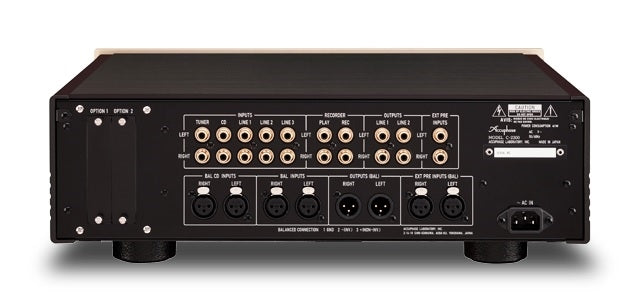
Balanced AAVA, Tone Controls and Room to Grow
The C-2300 is a solid-state, fully balanced line-stage preamplifier that brings Accuphase's C-2000 and C-2400 preamp lines together, replacing the C-2150 and C-2450. Accuphase has spent more than half a century refining the volume control, and the C-2300 uses Balanced AAVA, the balanced successor to AAVA, to set the level with no variable resistor in the signal path.
It earns its Precision Stereo Control Center name with a newly developed 4-band tone control and two option slots that let the line stage grow into a phono preamp (AD-60), a DAC with USB (DAC-60), or both.
TTVJ is an authorized Accuphase dealer. You're buying through the brand's own dealer network, with advice from someone who has set up these components in real listening rooms.
Is It Right for You?
A Great Fit If You Want
- Tone controls on an Accuphase preamp: four bands, with a choice of frequency for bass and treble. The C-2900 and C-3900S have loudness compensation only.
- One box for vinyl and digital: add the AD-60 phono board and the DAC-60 digital board, with optical, coaxial and USB inputs.
- A line preamp you can expand later: start with the line stage and add boards as your system grows.
- A lighter unit: 19.3 kg, against 24.2 kg for the C-2900 and 25.3 kg for the C-3900S.
Consider Something Else If You Need
- Two balanced outputs: the C-2300 has one XLR output. The C-2900 and C-3900S have two.
- The lowest-noise Accuphase preamp: the C-3900S uses Dual Balanced AAVA with ANCC (118 dB S/N).
- A 10 Ω MC load: the C-2900's AD-2900 phono unit offers 10–300 Ω; the AD-60 offers 30–300 Ω.
- One box instead of separates: Accuphase's integrated amplifiers, such as the E-800S, E-700, E-4000 and E-3000, combine a preamp and power amp.
Design
Balanced AAVA Volume Control
AAVA (Accuphase Analog Vari-gain Amplifier) removes every variable resistor from the signal path. The volume knob is only a position sensor; the music never passes through it. Balanced AAVA uses two AAVA modules in a fully balanced configuration, built with discrete circuitry.
Accuphase specifies residual noise at maximum volume of 5.6 µV, against 6.3 µV for the C-2450 it replaced, about 10% lower.
4-Band Tone Control
The 4-band tone control was newly developed for the C-2300. It uses additive active filters, the type found in graphic equalizers, across four bands: bass at 40 or 125 Hz, low midrange at 500 Hz, high midrange at 2 kHz, and treble at 8 or 20 kHz.
A loudness compensator adds +6 dB at 100 Hz for low-volume listening.
Circuits and Power Supply
The music-signal circuits use five unit amplifiers, separate for left and right. Each channel has its own transformer in its own case and two 10,000 µF filter capacitors. Logic-controlled relays switch the signal.
The headphone amplifier is discrete, with parallel push-pull output stages and its own power supply. The chassis rests on high-carbon cast iron insulators.
Controls
The volume sensor is machined from an aluminum block, with an 8 mm brass shaft, a DC motor and a floating mount for quiet remote operation. The other controls cover the tone control, gain (12, 18 or 24 dB), balance (adjusted through Balanced AAVA), mono, an output selector (all, line, balanced or off), a recorder selector and the display mode.
Polarity is set for each input and remembered. The front panel has the loudness and −20 dB attenuator buttons. The RC-250 remote, which also operates Accuphase CD players, is supplied.
Option Boards
Two Slots for Phono, Digital or Extra Line Inputs
| AD-60 phono board | MM and MC, switched from the front panel. Gain MM 40 dB, MC 66 dB. MC load 30, 100, 200 or 300 Ω, set from the C-2300's sub-panel; MM 47 kΩ fixed. Adds a 25 Hz subsonic filter (−12 dB/octave). Input sensitivity MM 2.5 mV, MC 0.126 mV; maximum input MM 60 mV, MC 3.0 mV. |
|---|---|
| DAC-60 digital board | USB (PCM up to 384 kHz/32-bit; DSD up to 11.2 MHz with ASIO, 5.6 MHz with DoP), coaxial (up to 192 kHz/24-bit) and optical (up to 96 kHz/24-bit), chosen with the C-2300's DAC input selector. One ESS ES9016K2M per channel, with its two converters run in parallel (Accuphase MDS+). |
| LINE-10 board | Adds a set of unbalanced line inputs (the older LINE-9 also fits) |
| Older boards | The slots also accept the AD-50, AD-30, AD-20, AD-10 and AD-9 phono boards and the DAC-50, DAC-40, DAC-30, DAC-20 and DAC-10 digital boards. With these, some settings are made on the board rather than the front panel (MC load and subsonic filter; MM/MC on the AD-10 and AD-9), and the DAC input selector works only with the DAC-60, DAC-50 and DAC-40. |
Connect It
Inputs and Outputs by Job
| Balanced sources (XLR) | 2 inputs: BAL CD and BAL |
|---|---|
| Line sources (RCA) | 5 inputs: TUNER, CD and LINE 1–3, plus recorder PLAY |
| Turntable | No phono input as delivered. Install the AD-60, or connect an external phono stage such as Accuphase's C-57 to a line or balanced input. |
| Digital sources | No digital input as delivered. Install the DAC-60 for USB, optical and coaxial, or use an external DAC. |
| Outputs to power amplifiers | 1 balanced (BAL) and 2 line (LINE 1, 2); rated 2 V, maximum 7.0 V, 50 Ω output impedance, loads of 600 Ω or more |
| External preamp | EXT PRE inputs, balanced and line, for switching in another preamplifier, for example a home-theater processor |
| Headphones | Front jack; 8 Ω or higher; 2 V into 40 Ω |
Setup and Matching
- Gain: the gain switch offers 12, 18 or 24 dB, and the output reaches 7.0 V maximum. Accuphase's current power amps need between 0.80 V (A-48S) and 1.95 V (P-7500) for full output at their maximum gain, so drive is ample. If you only ever use the bottom of the volume range, a lower gain setting gives you more of the dial to work with.
- Bi-amping: with one balanced output, a second amplifier connects to a line (RCA) output.
- Placement: it measures 465 × 150 × 405 mm (18.3 × 5.9 × 15.9 in), so allow extra depth for cables.
Reviews
FIDELITY: "The Standard Measure"
Instead, unconditional transparency gives the emotionality of the music free rein to unfold.
Polcyn heard the C-2300 as neutral and musical at once, with a very low noise floor and instruments placed convincingly in the room, from solo shamisen to large orchestral works. He praised the controls and the build, and treated the tone control as part of Accuphase's view that tonal adjustment has value. The review names no drawbacks.
C-2300 vs. Accuphase's Other Line-Stage Preamplifiers
C-2300, C-2900 and C-3900S
| C-2300 | C-2900 | C-3900S | |
|---|---|---|---|
| Volume control | Balanced AAVA | Balanced AAVA | Dual Balanced AAVA with ANCC |
| Balanced inputs | 2 | 2 | 4 |
| Line inputs | 5 | 5 | 6 |
| Balanced / line outputs | 1 / 2 | 2 / 2 | 2 / 2 |
| Phono | Optional AD-60 board | Optional AD-2900 unit | External (C-57) |
| Digital inputs | Optional DAC-60 board | None | None |
| Tone shaping | 4-band tone, loudness | 3-step loudness | 5-step loudness |
| S/N (A-weighted) | 111 dB | 113 dB | 118 dB |
| Size (W × H × D) | 465 × 150 × 405 mm | 477 × 156 × 412 mm | 477 × 156 × 412 mm |
| Weight | 19.3 kg | 24.2 kg | 25.3 kg |
Choose the C-2300 If You
- Want tone controls: 4-band, with selectable bass and treble frequencies.
- Want digital inputs in the preamp: the DAC-60 board; the C-2900 and C-3900S have no digital option.
- Want a lighter unit: 19.3 kg vs 24.2 kg or more.
Choose the C-2900 If You
- Feed two amps balanced: two XLR outputs vs one.
- Use a very low-impedance MC cartridge: the AD-2900 adds a 10 Ω load setting.
Choose the C-3900S If You
- Have many sources: four XLR and six RCA inputs, vs two and five.
- Want Accuphase's lowest-noise preamp: Dual Balanced AAVA with ANCC, 118 dB S/N.
Not Sure Which to Choose?
Deciding between the C-2300, C-2900 and C-3900S, or which option boards to add? Todd can talk it through with you.
Specifications
Accuphase C-2300 Specifications
| Type | Solid-state, fully balanced line-stage preamplifier; two option slots |
|---|---|
| Volume control | Balanced AAVA; −20 dB attenuator |
| Frequency response | 20 Hz–20 kHz, +0/−0.2 dB; 3 Hz–200 kHz, +0/−3.0 dB (balanced and line); AD-60: 20 Hz–20 kHz, ±0.3 dB |
| Total harmonic distortion | 0.005% (20 Hz–20 kHz, rated output) |
| Crosstalk | −74 dB (10 kHz) |
| S/N ratio (balanced and line) | 111 dB (A-weighted, input shorted); 108 dB (EIA) |
| Gain | 12, 18 or 24 dB (balanced/line in to balanced/line out); 0 dB to REC; with AD-60 (at 18 dB): MM 58 dB, MC 84 dB |
| Input sensitivity | 252 mV for rated output; 63 mV for 0.5 V output (gain 18 dB) |
| Input impedance | Balanced 40 kΩ; line 20 kΩ |
| Maximum input | 6.0 V (balanced and line) |
| Output | Rated 2 V, maximum 7.0 V, 50 Ω output impedance, load 600 Ω or more; REC 252 mV, 200 Ω, load 10 kΩ or more |
| Inputs | 2 balanced (XLR), 5 line (RCA), EXT PRE (balanced and line), recorder PLAY; 2 option slots |
| Outputs | 1 balanced, 2 line, recorder REC, headphones |
| Tone control | 4 bands: 40 or 125 Hz, 500 Hz, 2 kHz, 8 or 20 kHz |
| Loudness compensator | +6 dB at 100 Hz |
| Headphone output | Discrete; 8 Ω or higher; 2 V into 40 Ω |
| Power requirements | 120 V, 220 V or 230 V AC, 50/60 Hz, as marked on the rear panel |
| Power consumption | 41 W with AD-60 and DAC-60 installed |
| Dimensions (W × H × D) | 465 × 150 × 405 mm (18.3 × 5.9 × 15.9 in) |
| Weight | 19.3 kg (42.5 lb) net; 25 kg in carton |
| In the box | RC-250 remote commander; AL-10 audio cable (1 m); AC power cord |
Order Your Accuphase C-2300 Precision Preamplifier
As an authorized Accuphase dealer, TTVJ handles your order personally, from confirming the configuration to delivery. Reach Todd by phone or message to:
- Confirm current pricing and availability
- Discuss a trade-in of your current preamplifier
- Ask about financing and shipping