


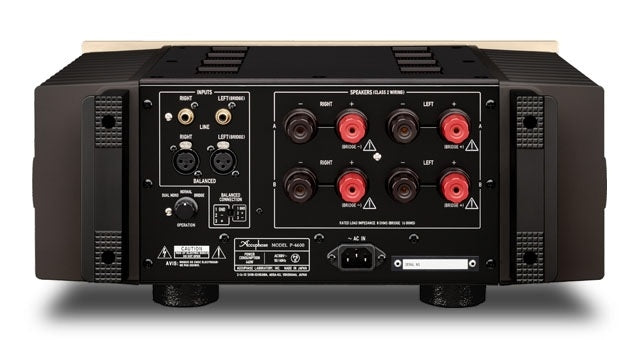
Class AB Driving Power for Large Speakers
The P-4600 is a Class AB, solid-state stereo power amplifier built, in Accuphase's words, for supreme driving performance. A 6-parallel push-pull stage of bipolar power transistors per channel delivers 150 W into 8 ohms, with ratings of 300 W into 4 ohms and 450 W into 2 ohms (music signals). A three-stage Darlington configuration limits the effect of the speaker's back-EMF on the output stage, and balanced remote sensing helps give it a guaranteed damping factor of 800.
It replaces the P-4500, raising guaranteed S/N from 121 to 125 dB and the damping factor from 700. It is the smaller of Accuphase's two Class AB stereo power amps, at 190 mm high, 427 mm deep and 30.0 kg, and it idles at 94 W.
TTVJ is an authorized Accuphase dealer. You're buying through the brand's own dealer network, with advice from someone who has set up these amplifiers in real listening rooms.
Is It Right for You?
A Great Fit If You Want
- Power for large speakers in a 190 mm-high chassis: 150 W/ch into 8 ohms, with a damping factor of 800.
- Low idle draw: 94 W, against 200–230 W for Accuphase's Class A power amps.
- To switch between two pairs of speakers: A and B speaker terminals with a front-panel selector.
- A path to more power: add a second P-4600 later and bridge the pair (600 W each into 8 ohms), or run two in dual mono for bi-amping.
Consider Something Else If You Need
- More power and a higher S/N rating: the P-7500 gives 300 W/ch and 130 dB S/N (see the comparison below).
- Very low-impedance speakers: the P-4600 is rated for loads of 4–16 ohms (2 ohms with music signals only). Accuphase's A-48S and A-80 Class A amps are rated for 2–16 ohms, though at lower power into 2 ohms (200 and 260 W).
- Class A operation: Accuphase's Class A power amps are the A-48S, A-80 and A-300.
Design
Bipolar Output Stage
Each channel's output stage is a 6-parallel push-pull arrangement of high-output bipolar transistors rated 150 W/15 A, operating in Class AB as the final stage of a three-stage Darlington configuration. The P-4500 used a 4-parallel stage. The left and right power amplifier sections are kept separate, in a mono-block design.
Balanced remote sensing takes feedback for both signal and ground close to the speaker terminals, and a MOS-FET switch (1.6 mΩ on-resistance, against 2.0 mΩ on the P-4500) replaces mechanical relays in the speaker protection circuit. The guaranteed damping factor is 800.
Low-Noise Input Stage
The input stage is a balanced instrumentation amplifier. Accuphase gives it most of the gain (12.6×, or 22 dB) and leaves 2× (6 dB) to the power stage, and the gain selector works in the input amplifier rather than through an attenuator. MCS+ runs the voltage amplification stage as two parallel circuits, which Accuphase says lowers the noise floor by about 30% in theory, and current-feedback topology keeps frequency response nearly unchanged as you switch gain.
Guaranteed output noise is 19.5 µV, about 18% lower than the P-4500's 23.9 µV.
Power Supply and Protection
A large, custom high-efficiency toroidal transformer feeds two custom 50,000 µF filter capacitors. The chassis stands on high-carbon cast iron insulators under an aluminum top plate with a hairline finish.
Photo-couplers detect speaker short circuits, and temperature sensors on the heat sinks watch for overheating. When protection operates, the output is cut and the meters flash.
Controls and Meters
Large analog needle power meters on a logarithmic scale (−∞ to +3 dB) read down to −50 dB. Peak hold can be set to 0, 3 seconds or infinite, and the meters can be switched off.
The front panel has the input selector, the gain selector and the speaker and meter display selectors. The rear panel has the operation selector (stereo, bridge or dual mono) and a polarity selector for the balanced input.
Connect It
Inputs, Outputs and Operating Modes
| Inputs | 1 balanced (40 kΩ) and 1 line (20 kΩ), chosen with the front-panel input selector; balanced polarity selectable |
|---|---|
| Speaker outputs | A and B terminals with a front-panel speaker selector; spade lugs from 7 to 16 mm |
| Gain selector | MAX (28 dB), −3 dB (25 dB), −6 dB (22 dB), −12 dB (16 dB) |
| Stereo | 150 W/ch into 8 Ω; 300 W/ch into 4 Ω; 450 W/ch into 2 Ω (4 and 2 Ω: music signals). Loads of 4–16 Ω, or 2–16 Ω with music signals. |
| Bridged (two units, one per channel) | 600 W into 8 Ω; 900 W into 4 Ω (music signals). Loads of 8–16 Ω, or 4–16 Ω with music signals. Needs 2.76 V input for rated output. |
| Dual mono bi-amping (two units) | Set both units to DUAL MONO, one P-4600 per speaker driving its low and high sections. Load ranges are the same as in stereo. The speakers need separate low and high inputs. |
Setup Notes
- Placement: it weighs 30.0 kg (66.2 lb) and needs 427 mm (16.8 in) of depth and 190 mm (7.5 in) of height.
- Speaker impedance: check your speakers' minimum impedance against the load ranges above, especially before bridging, where the minimum is 8 ohms (4 ohms with music signals).
Pairing
With a Preamplifier
At maximum gain the P-4600 reaches full rated output with 1.38 V at its input (2.76 V when bridged). Accuphase's current preamplifiers, the C-3900S, C-2900 and C-2300, have a rated output of 2 V.
With high-efficiency speakers, try a lower gain setting so you use more of the preamp's volume range. The amp's own guaranteed S/N rises from 125 to 130 dB at −12 dB.
With an Accuphase Integrated
Accuphase's integrated amplifiers can bi-amp through their pre outputs, and they specify equal gain for both amplifiers. The power sections of the E-800S, E-700, E-4000, E-3000 and E-5000 all run at 28 dB, the same as the P-4600 at its MAX setting.
Feed the P-4600 from the integrated's pre out and let it drive one range of the speakers. The speakers need separate low and high inputs with a built-in crossover.
Reviews
Hi-Fi Voice (Czech Republic): Reference Platinum Note
Daniel Březina (May 2024) tested the P-4600 with Fyne Audio F704 speakers, comparing it with Accuphase's E-5000 integrated and A-80 power amp. He found it controlled and musical, with authoritative bass once warmed up, a smooth, natural midrange with a slightly warm, relaxed balance, and a wider, deeper soundstage than the E-5000's. He praised its control of the speakers, its build and its choice of operating modes. His reservations: the styling is somewhat old-fashioned, it is no lightweight at 30 kg, the bass needs warm-up time to reach full strength, and its warm, soft character is not one he'd choose for death metal.
Read the review (Czech): Hi-Fi Voice
P-4600 vs. P-7500
Accuphase's Two Class AB Stereo Power Amps
| P-4600 | P-7500 | |
|---|---|---|
| Type | Class AB stereo | Class AB stereo |
| Output stage | 6-parallel bipolar | 10-parallel power transistors |
| Power, 8 Ω | 150 W/ch | 300 W/ch |
| Power, 4 Ω (music signals) | 300 W/ch | 600 W/ch |
| Power, 2 Ω (music signals) | 450 W/ch | 900 W/ch |
| Bridged, 8 / 4 Ω (music signals) | 600 / 900 W | 1,200 / 1,800 W |
| Input for rated output | 1.38 V | 1.95 V |
| Damping factor | 800 | 1,000 |
| S/N (max gain) | 125 dB | 130 dB |
| Speaker terminals | A and B, with selector | Two pairs, same signal |
| Size (W × H × D) | 465 × 190 × 427 mm | 465 × 238 × 515 mm |
| Weight | 30.0 kg | 49.0 kg |
| Idle power draw | 94 W | 142 W |
Choose the P-4600 If You
- Have a low or shallow shelf: 190 mm high and 427 mm deep, vs 238 and 515 mm.
- Need a lighter amp to place: 30.0 vs 49.0 kg.
- Want less heat and lower idle draw: 94 vs 142 W.
- Want to switch between two pairs of speakers: A/B selector; the P-7500 feeds both pairs at once.
Choose the P-7500 If You
- Need the most power: 300 vs 150 W into 8 ohms, 900 vs 450 W into 2 ohms.
- Plan to bridge into 4-ohm speakers: 1,800 vs 900 W per bridged unit (music signals).
Not Sure Which to Choose?
Deciding between the P-4600 and the P-7500, or how to match one to your preamp or integrated? Todd can talk it through with you.
Specifications
Accuphase P-4600 Specifications
| Type | Class AB solid-state stereo power amplifier |
|---|---|
| Rated output (20 Hz–20 kHz, 0.05% THD) | Stereo: 150 W/ch into 8 Ω; 300 W/ch into 4 Ω*; 450 W/ch into 2 Ω* Bridged: 600 W into 8 Ω*; 900 W into 4 Ω* *Music signals only |
| Output stage | 6-parallel push-pull bipolar power transistors, Class AB |
| Total harmonic distortion (20 Hz–20 kHz) | Stereo: 0.05% (2 Ω); 0.03% (4–16 Ω) Bridged: 0.05% (4–16 Ω) |
| Intermodulation distortion | 0.01% |
| Frequency response | At rated output: 20 Hz–20 kHz, +0/−0.2 dB At 1 W: 0.5 Hz–160 kHz, +0/−3.0 dB |
| Damping factor | 800 or more (stereo) |
| Gain | 28 dB (MAX), 25 dB (−3 dB), 22 dB (−6 dB), 16 dB (−12 dB) |
| Input sensitivity | Stereo: 1.38 V at rated output; 0.11 V at 1 W Bridged: 2.76 V at rated output; 0.11 V at 1 W |
| Input impedance | Balanced 40 kΩ; line 20 kΩ |
| S/N ratio (A-weighted, input shorted) | 125 dB (gain MAX); 130 dB (gain −12 dB) |
| Power meters | Analog, logarithmic, −∞ to +3 dB; peak hold 0, 3 s or infinite; display off |
| Inputs | 1 balanced, 1 line |
| Outputs | Speaker terminals A and B, with selector; spade lugs 7–16 mm |
| Load impedance | Stereo and dual mono: 4–16 Ω (2–16 Ω, music signals) Bridged: 8–16 Ω (4–16 Ω, music signals) |
| Operating modes | Stereo, dual mono (bi-amping), bridged |
| Power requirements | 120 V, 220 V or 230 V AC, 50/60 Hz, as marked on the rear panel |
| Power consumption | 94 W idle; 0.3 W standby |
| Dimensions (W × H × D) | 465 × 190 × 427 mm (18.3 × 7.5 × 16.8 in) |
| Weight | 30.0 kg (66.2 lb) net |
| In the box | AC power cord |
Order Your Accuphase P-4600
As an authorized Accuphase dealer, TTVJ handles your order personally, from confirming the configuration to delivery. Reach Todd by phone or message to:
- Confirm current pricing and availability
- Discuss a trade-in of your current amplifier
- Ask about financing and shipping