


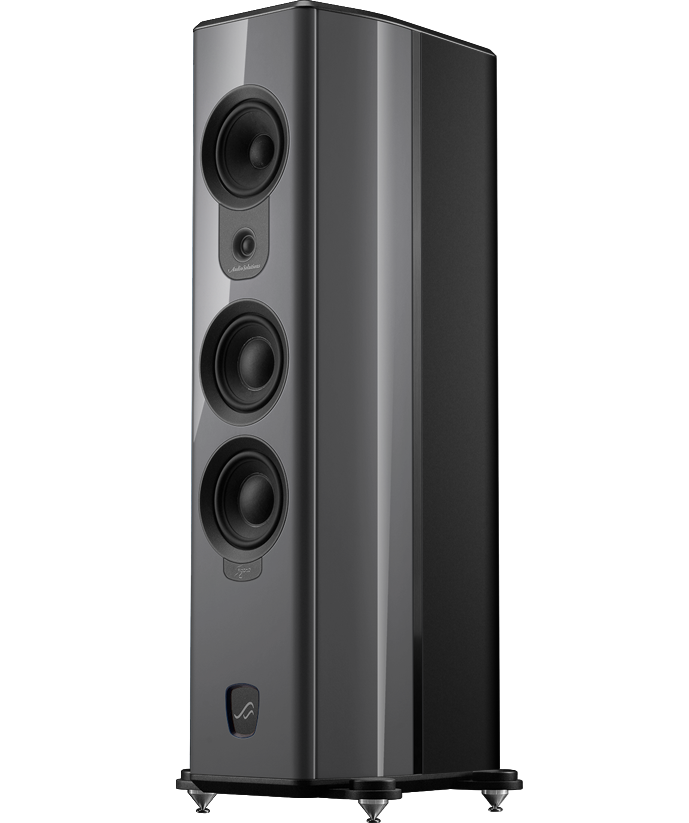
In addition to the 4 standard model configurations available , you can also custom configure your AudioSolutions Figaro Speakers to fit your personal style and taste. Built them with an assortment of colors and custom upgrades.
Click here and create the speakers of your dreams!
https://my.audiosolutions.lt/,action.templates_list,gid.1
Pricing varies in accordance with your custom configuration. We can help you configure your speakers or you can do it yourself at the above link. Call us with your custom configuration code or for assistance creating your own speakers at 406-285-3910
The Figaro S2 sounds smooth, tonally rich, spacious, dynamic, and controlled, with an especially natural vocal band, refined treble, and taut rather than bloated bass. It is a speaker that appears designed to make music sound large and involving without resorting to brightness or artificial detail enhancement.
Meet the all-new Figaro! An evolution of our most successful speaker series. Five years have passed since the original Figaro was introduced in 2018 and yet we are pushing the limits once again. The new Figaro is vastly improved in all aspects. Embrace a new modern design with brass metal accents and satin color options. We give you a remarkable tandem of performance and design where science meets art.
Description
Figaro! maintains timeless AudioSolutions design. Designed to be easily driven by most amplifiers and with the ability to be placed very close to the wall. Figaro's task is to make your life easier with as simple as possible setup, cable, and amplifier matching. We wish you many great moments while listening to your Figaro.
Features
Three-way speaker system designed with Mini-Horn loaded silk dome tweeter and our unique midrange driver which works in extended mid-band effectively making it an Extended-Band driver, allowing us to push crossover frequencies of the drivers further away from the most critical area for the human ear - 1000-1500Hz and thus reduce crossover distortions and perception of them. Two whole new re-designed ER (Extra Rigid) hard paper cone bass drivers deliver faster and deeper bass response and improve overall sound clarity.
The Cabinet-In-a-Cabinet enclosure system taken from upper scale Virtuoso series contributes to a complex closed system that eliminates unwanted resonances by turning acoustical energy into heat, allowing all drivers to perform with precision and dynamics.
Figaro features outriggers with height-adjustable spikes, WBT NextGen connection terminals with bi-amping for models L and XL, and also a whole new 6 unique never seen before satin finishes with brass metal accents.
Specifications
Dimensions speaker only (HxWxD) : 950mm x 230mm x 401mm; 37.4 x 9.1 x 15.8in
Dimensions with outriggers (HxWxD) : 980mm x 356mm x 401mm; 38.6 x 14.0 x 15.8in
Weight : 31 kg/68.3 lbs each
Shipping weight : 34 kg/75 lbs each
Sensitivity : 91 dB @ 2.83V 1m
Suggested amp power : 10-250 W;
Impedance : nominal 4,0 ohms;
Crossover frequency : 400 Hz; 4000 Hz
Frequency response (in-room environment) : 35-25000 Hz
Drivers : 19mm silk dome tweeter, 15.2cm ER paper cone mid, two 15.2cm ER paper cone bass drivers
Mini Horn Loading
Figaro utilizes a Mini-Horn loading technology to cope with the infamous soft domes problem - cone breakup and cone "walk". Cone breakup and "walk" happens when a soft dome tweeter is being driven hard at high signal levels. Distortions rise exponentially because:
a) when a certain point in signal level and thus dome acceleration/amplitude is reached, the center part of the dome flexes in an uncontrolled fashion due to the silk's soft nature
b) differences in air pressure behind the dome and in front of the dome creates a nonlinear environment and overcome suspension ability to prevent axial movement of the cone
Our Mini-Horn is based on acoustical dampening which happens at the frontal dome area. We carefully measure at which frequencies the dome starts to flex and emit an avalanche of distortions. Mini-Horn then is designed and manufactured according to desired specifications to dampen those frequencies. The result is a proportional dampening of the tweeters’ movement. The louder it plays the more dampening and air pressure on the frontal area it gets from its own emitted sound. It is described as acoustical impedance and is highly dependent on the Mini-Horn's shape. Another positive by-product of this process is that Mini-Horn adds sensitivity and thus the efficiency of the driver.
Extended Band Midrange
The human ear has uneven sensitivity to different frequencies. We are naturally less sensitive to high frequencies and especially to low frequencies. The exception is sensitivity to mid frequencies in the 1000-2000Hz band due to evolution. Simply put - in nature, the sounds of life-threatening events lie more or less in 1000-2000Hz diapason, so naturally, we are most sensitive to that so we could stay alert. The downside of this phenomenon in this rather safe modern world is that we can hear and pinpoint the slightest imperfections in reproduced sound at those frequencies. And imperfections in sound reproduction are called distortions.
Most of the manufacturers calculate crossover points in exactly this area of 1000-2000Hz. Since each driver has its natural spectrum of distortions we actually can hear the transition from one driver to another, let alone an additional distortions caused by the crossover phase shift. The resulting sound is described as an unnatural or multi-way sound. It is not possible to completely eliminate natural-born driver's distortions or the phase shift in crossover which is mathematically tied to how db/oct crossover is calculated. The only way to fight this is to utilize crossover points away from this region of 1-2kHz. For that reason, we created an Extended Band Midrange driver. Crossover points of 400-4000Hz are one octave away from the sensitive band. Not only this solution helps with crossover distortion perception but the listener gets uniform, unchopped sound coming from one driver with virtually zero phase shift. Homogenous sound in our opinion is one of the biggest goals in the audio industry.
Cabinet In A Cabinet System
The new Figaro! speakers share a Cabinet-In-a-Cabinet enclosure design. This system is based on two separate enclosures - an inner cabinet and an outer cabinet bonded together by a thin layer of Polyurethane. The inner cabinet is manufactured of a lightweight yet rigid material that controls primary vibrations by absorbing acoustical power coming from the drivers. Then a thin layer of viscous Polyurethane situated in between the inner and outer cabinets acts as a dampening layer which converts vibrations born in the inner cabinet to heat. The residue of vibrations is then dampened by the outer cabinet which is manufactured of a much heavier and less dense material that acts as a mass damper.
ER Cone Bass Drivers
Second generation Figaro speaker utilizes re-designed bass drivers with ER paper cones. Er stands for Extra Rigid paper. It is actually visible on the cone surface as flakes of hard pulp and fibers and is natural to rigid cones. ER paper cones were chosen due to all the pros of traditional paper cones and the pros of hard material cones. Hard cones (metal, ceramic, etc.) provide uniform push-pull movement where all cone's points act as a uniform piston which is desirable. Con is that hard cones have the potential to have early break-up points and ringing due to a lack of dampening properties inside the material itself. Paper on the other hand does not have break-up points as it is quite soft and flexible but it does not act as a piston, and usually, the edge of the paper cone are fluttering, and all cone is flexing. Having positive properties of paper and introducing hardening materials like sturdy fibers and hard pulp gives us a unique cone that acts as a piston, but at the same time does not have ringing or early cone breakup points. ER cones allowed us to introduce new piston-like bass drivers and of course our Extended Band Midrange.
Exclusive Customization
AudioSolutions' Exclusive Personalisation team is ready to help you to customize your speaker. Please address us for custom coloring or style. We can do small changes and we can make completely tailor-made speakers. Our team works in conjunction with architects, and designers and is ready to make a one-of-one product for your living room.
Please visit MY.AUDIOSOLUTIONS.LT to use our speaker configurator and design your speakers the way you like them best.
So, How does it sound???
The AudioSolutions Figaro S2 is voiced more toward natural ease, musical flow, and full-bodied scale than hyper-etched “hi-fi” spectacle. Expect a clean, open, non-fatiguing presentation with surprisingly substantial bass and a notably coherent midrange—provided it is partnered with an amplifier comfortable driving a nominal 4-ohm speaker.
Overall character
Think of the Figaro S2 as a refined, energetic three-way floorstander rather than a lean, ultra-analytical monitor in a tall cabinet. Its likely sonic signature is:
-
Smooth and organic rather than sharp or aggressively forward.
-
Clear and transparent, but not tilted toward treble brilliance.
-
Dynamically capable: it should retain life and impact at realistic listening levels.
-
Spacious and well-imaged, with a large soundstage relative to its narrow front baffle.
-
Full through the lower midrange and bass, without being designed as a “one-note” warmth machine.
The S2 uses a 19 mm mini-horn-loaded silk-dome tweeter, a dedicated 152 mm paper-cone midrange, and two 152 mm dedicated paper-cone bass drivers. Its 400 Hz and 4 kHz crossover points deliberately keep crossover transitions away from the especially sensitive 1–1.5 kHz vocal-presence region, which helps explain why the design is likely to sound seamless and convincing through voices and acoustic instruments.
Treble
The top end is silky, airy, and controlled, not metallic or aggressively incisive. The small silk dome and shallow horn loading aim to preserve dispersion and dynamic expression while avoiding the hard glare that can make recordings with hot mastering or close-miked vocals fatiguing.
In practical terms:
-
Cymbals should sound textured and extended rather than splashy.
-
Strings and brass should have sheen without becoming glassy.
-
Sibilants should be less exaggerated than through a bright metal-dome or aggressively voiced AMT design.
-
Poor recordings may remain listenable, especially at higher volume.
That character is consistent with commentary on the earlier Figaro S, whose treble was described as transparent and fluid, with no grain or harshness; the related Figaro M2 has also been characterized as elegantly smooth and natural.
Midrange and imaging
The midband is the Figaro S2’s strongest suit. A dedicated paper-cone midrange covering roughly 400 Hz to 4 kHz should give it a more relaxed, unforced vocal presentation than a conventional two-way asking one driver to handle bass, midrange, and the critical vocal band simultaneously.
Expect:
-
Vocals with body, believable scale, and little obvious crossover “stitching.”
-
Good separation of dense mixes without pulling individual images artificially forward.
-
Acoustic guitar, piano, woodwinds, and strings to sound harmonically complete rather than thin.
-
A soundstage that is wide and stable, with convincing layering when the recording supports it.
The cabinet’s asymmetrical curved sidewalls and Cabinet-in-a-Cabinet construction are intended to reduce enclosure coloration, so the midrange should come across as less “boxy” and more detached from the loudspeaker than one might expect from a relatively compact floorstander.
Bass and dynamics
For a 95 cm / 37.4-inch floorstander with dual 6-inch woofers, the S2 sounds quick, articulate, and satisfyingly weighty, rather than merely huge. AudioSolutions rates in-room response down to 35 Hz, and the Mk2 redesign added dedicated bass drivers rather than using mid-bass units for low-frequency duty.
That suggests bass with:
-
Better pitch definition on bass guitar and double bass.
-
Fast attack on kick drum and orchestral percussion.
-
More controlled low-end than a thick, soft, port-tuned “big bass” speaker.
-
Enough extension and dynamic authority for most music in small-to-medium or moderately large rooms.
It may not produce the lowest organ-pedal or electronic sub-bass foundation of a physically larger three-way such as the Figaro M2, and rear ports mean placement will still affect warmth and bass weight. But its manufacturer specifically positions it as a speaker that can work relatively close to a wall, which is useful for real-world rooms.
What it will suit
The Figaro S2 should be especially rewarding if you want a speaker for long, immersive sessions across vocal jazz, rock, orchestral music, acoustic recordings, soul, blues, and well-recorded electronic music—music where tonal color, dynamics, soundstage, and low listening fatigue matter as much as microscopic treble detail.
It will likely appeal less if your priority is:
-
Extreme studio-monitor neutrality or ruthlessly exposed recording flaws.
-
A sharply forward, ultra-vivid presence region.
-
The deepest sub-30 Hz bass without a subwoofer.
-
Easy loading for low-current amplifiers: its stated 91 dB sensitivity is helpful, but the nominal impedance is 4 ohms, so amplifier current delivery still matters.