


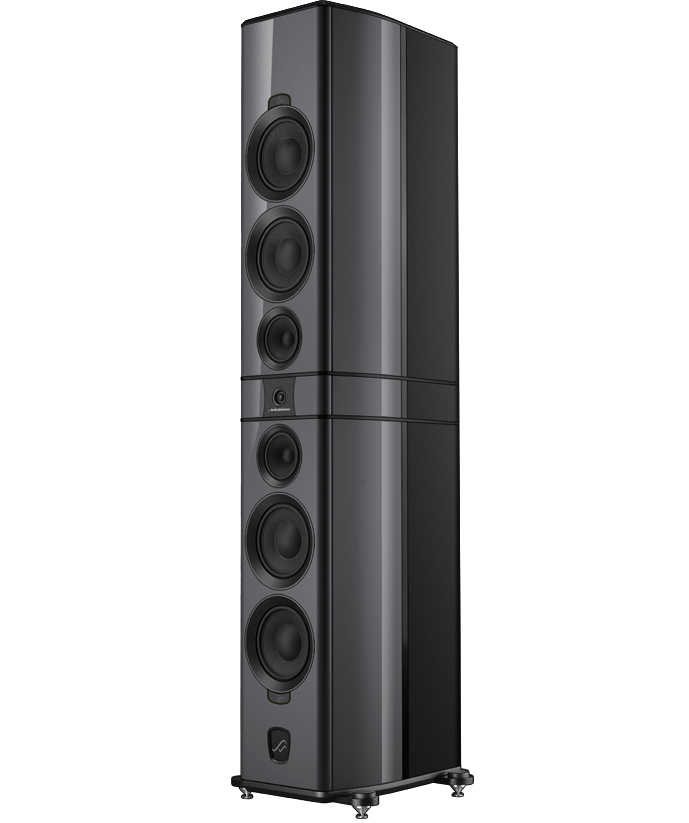
In addition to the 4 standard model configurations available , you can also custom configure your AudioSolutions Figaro Speakers to fit your personal style and taste. Built them with an assortment of colors and custom upgrades.
Click here and create the speakers of your dreams!
https://my.audiosolutions.lt/,action.templates_list,gid.1
Pricing varies in accordance with your custom configuration. We can help you configure your speakers or you can do it yourself at the above link. Call us with your custom configuration code or for assistance creating your own speakers at 406-285-3910
Meet the all-new Figaro! An evolution of our most successful speaker series. Five years have passed since the original Figaro was introduced in 2018 and yet we are pushing the limits once again. The new Figaro is vastly improved in all aspects. Embrace a new modern design with brass metal accents and satin color options. We give you a remarkable tandem of performance and design where science meets art.
Description
Figaro! maintains timeless AudioSolutions design. Designed to be easily driven by most amplifiers and with the ability to be placed very close to the wall. Figaro's task is to make your life easier with as simple as possible setup, cable, and amplifier matching. We wish you many great moments while listening to your Figaro.
Features
Three-way speaker system designed with Mini-Horn loaded silk dome tweeter and our unique midrange driver which works in extended mid-band effectively making it an Extended-Band driver, allowing us to push crossover frequencies of the drivers further away from the most critical area for the human ear - 1000-1500Hz and thus reduce crossover distortions and perception of them. Two whole new re-designed ER (Extra Rigid) hard paper cone bass drivers deliver faster and deeper bass response and improve overall sound clarity.
The Cabinet-In-a-Cabinet enclosure system taken from upper scale Virtuoso series contributes to a complex closed system that eliminates unwanted resonances by turning acoustical energy into heat, allowing all drivers to perform with precision and dynamics.
Figaro features outriggers with height-adjustable spikes, WBT NextGen connection terminals with bi-amping for models L and XL, and also a whole new 6 unique never seen before satin finishes with brass metal accents.
Specifications
Dimensions speaker only (HxWxD) : 1918mm x 336mm x 581mm; 75.51 x 13.23 x 22.87in
Dimensions with outriggers (HxWxD) : 1948mm x 472mm x 581mm; 76.7 x 18.6 x 22.87in
Weight : 115 kg/253 lbs each
Shipping weight : 157 kg/346 lbs each
Sensitivity : 92 dB @ 2.83V 1m
Suggested amp power : 20-900 W;
Impedance : nominal 8,0 ohms
Crossover frequency : 400 Hz; 4000 Hz
Frequency response (in-room environment) : 24-25000 Hz
Drivers : 19mm silk dome tweeter, two 15.2cm ER paper cone mids, four 23.3cm ER paper cone bass drivers
Mini Horn Loading
Figaro utilizes a Mini-Horn loading technology to cope with the infamous soft domes problem - cone breakup and cone "walk". Cone breakup and "walk" happens when a soft dome tweeter is being driven hard at high signal levels. Distortions rise exponentially because:
a) when a certain point in signal level and thus dome acceleration/amplitude is reached, the center part of the dome flexes in an uncontrolled fashion due to the silk's soft nature
b) differences in air pressure behind the dome and in front of the dome creates a nonlinear environment and overcome suspension ability to prevent axial movement of the cone
Our Mini-Horn is based on acoustical dampening which happens at the frontal dome area. We carefully measure at which frequencies the dome starts to flex and emit an avalanche of distortions. Mini-Horn then is designed and manufactured according to desired specifications to dampen those frequencies. The result is a proportional dampening of the tweeters’ movement. The louder it plays the more dampening and air pressure on the frontal area it gets from its own emitted sound. It is described as acoustical impedance and is highly dependent on the Mini-Horn's shape. Another positive by-product of this process is that Mini-Horn adds sensitivity and thus the efficiency of the driver.
Extended Band Midrange
The human ear has uneven sensitivity to different frequencies. We are naturally less sensitive to high frequencies and especially to low frequencies. The exception is sensitivity to mid frequencies in the 1000-2000Hz band due to evolution. Simply put - in nature, the sounds of life-threatening events lie more or less in 1000-2000Hz diapason, so naturally, we are most sensitive to that so we could stay alert. The downside of this phenomenon in this rather safe modern world is that we can hear and pinpoint the slightest imperfections in reproduced sound at those frequencies. And imperfections in sound reproduction are called distortions.
Most of the manufacturers calculate crossover points in exactly this area of 1000-2000Hz. Since each driver has its natural spectrum of distortions we actually can hear the transition from one driver to another, let alone an additional distortions caused by the crossover phase shift. The resulting sound is described as an unnatural or multi-way sound. It is not possible to completely eliminate natural-born driver's distortions or the phase shift in crossover which is mathematically tied to how db/oct crossover is calculated. The only way to fight this is to utilize crossover points away from this region of 1-2kHz. For that reason, we created an Extended Band Midrange driver. Crossover points of 400-4000Hz are one octave away from the sensitive band. Not only this solution helps with crossover distortion perception but the listener gets uniform, unchopped sound coming from one driver with virtually zero phase shift. Homogenous sound in our opinion is one of the biggest goals in the audio industry.
Cabinet In A Cabinet System
The new Figaro! speakers share a Cabinet-In-a-Cabinet enclosure design. This system is based on two separate enclosures - an inner cabinet and an outer cabinet bonded together by a thin layer of Polyurethane. The inner cabinet is manufactured of a lightweight yet rigid material that controls primary vibrations by absorbing acoustical power coming from the drivers. Then a thin layer of viscous Polyurethane situated in between the inner and outer cabinets acts as a dampening layer which converts vibrations born in the inner cabinet to heat. The residue of vibrations is then dampened by the outer cabinet which is manufactured of a much heavier and less dense material that acts as a mass damper.
ER Cone Bass Drivers
Second generation Figaro speaker utilizes re-designed bass drivers with ER paper cones. Er stands for Extra Rigid paper. It is actually visible on the cone surface as flakes of hard pulp and fibers and is natural to rigid cones. ER paper cones were chosen due to all the pros of traditional paper cones and the pros of hard material cones. Hard cones (metal, ceramic, etc.) provide uniform push-pull movement where all cone's points act as a uniform piston which is desirable. Con is that hard cones have the potential to have early break-up points and ringing due to a lack of dampening properties inside the material itself. Paper on the other hand does not have break-up points as it is quite soft and flexible but it does not act as a piston, and usually, the edge of the paper cone are fluttering, and all cone is flexing. Having positive properties of paper and introducing hardening materials like sturdy fibers and hard pulp gives us a unique cone that acts as a piston, but at the same time does not have ringing or early cone breakup points. ER cones allowed us to introduce new piston-like bass drivers and of course our Extended Band Midrange.
Exclusive Personalization Program
AudioSolutions' Exclusive Personalisation team is ready to help you to customize your speaker. Please address us for custom coloring or style. We can do small changes and we can make completely tailor-made speakers. Our team works in conjunction with architects, and designers and is ready to make a one-of-one product for your living room.
Please visit MY.AUDIOSOLUTIONS.LT to use our speaker configurator and design your speakers the way you like them best.
So, How do the XL2 Speakers Sound???
The Figaro XL2 sounds large-scale, full-bodied, dynamically effortless, and unusually smooth through the presence region rather than hyper-etched or aggressively “audiophile” in character. Its design points toward a speaker that combines deep, weighty bass with a coherent, natural midband and a refined silk-dome top end.
Overall character
The XL2 as a big, room-filling loudspeaker voiced for physical scale and musical continuity:
-
Four 23.3 cm paper-cone woofers should provide serious low-frequency authority—more about pressurizing a room and reproducing kick-drum weight, orchestral foundation, and electric-bass body than about sounding lean or lightweight.
-
The two extended-band midrange drivers cover a broad 400 Hz–4 kHz span. That keeps crossover transitions away from the especially sensitive 1–1.5 kHz region, which should help voices, guitars, piano, and the body of acoustic instruments emerge as a single, unbroken presentation rather than as separate driver “bands.”
-
A small horn-loaded silk-dome tweeter delivers a controlled dispersion, good projection, and lively transient expression, but silk rather than metal-dome treble texture: refined, forgiving, and more textural than sharp.
In short: expect authority without obvious aggression, with a broad, solid image and a sense that the music has real mass behind it.
Bass and dynamics
The XL2 should be especially persuasive with music that needs scale:
-
Rock and electronic music ought to have substantial punch and low-end grip.
-
Large orchestral works should benefit from the speaker’s stated 24 Hz in-room extension and from the cabinet’s sheer air-moving capacity.
-
Drums should feel physical—kick drum and toms in particular—while the multiple woofer area gives the speaker a strong sense of ease at higher listening levels.
The paper-cone bass drivers are intended to favor speed and clarity as well as extension, so the goal is not merely “more bass.” If correctly positioned and driven, the better outcome should be dense but articulate bass, with a clearer separation between bass lines, room ambience, and the lower registers of piano or cello.
That said, this is a 75.5-inch-tall, 253-pound speaker with four large bass drivers per cabinet. In a small or acoustically lively room, its low-end potential can easily become the dominant part of the presentation. Room placement and amplifier damping will matter.
Midrange and treble
The extended-band midrange arrangement is probably the XL2’s most consequential sonic feature. Because each midrange driver is asked to operate across much of the vocal and instrumental core, the speaker is engineered to reduce the perception of crossover discontinuities where hearing is most sensitive. AudioSolutions describes the intended result as more uniform, less “chopped” sound with fewer perceptible phase effects.
In listening terms, that should translate to:
-
Vocals with continuous chest, throat, and breath rather than an over-lit upper-mid emphasis.
-
Piano with a more believable handoff from lower-register body to upper-register attack.
-
Good instrumental density: saxophone, cello, electric guitar, and male vocal should sound fleshy rather than skeletal.
-
Treble that offers air and focus without the hard, metallic glare that some listeners associate with highly forward dome or compression-driver implementations.
The mini-horn loading adds some immediacy and image focus, so it is not soft or overly polite. Rather, it delivers presence and projection without a sharp leading edge.
Imaging and scale
The Figaro XL2 is unlikely to behave like a tiny stand-mount that produces a miniature, sharply outlined soundstage. Its strengths should be image size, height, density, and macrodynamic spatiality:
-
A vocalist or solo instrument should have realistic physical dimensions instead of appearing as a pin-point cutout.
-
Recorded venues and large ensembles should expand beyond the cabinets more readily at realistic levels.
-
The tall baffle and driver array may yield a more elevated, life-size presentation—particularly satisfying with symphonic recordings, live jazz, organ, and full-band material.
The Cabinet-in-a-Cabinet construction is intended to suppress enclosure vibration by isolating an inner cabinet from the heavy outer enclosure with damping material. If it works as intended, that should help the XL2 retain clarity during loud passages, avoiding the slight thickening or “box talk” that can obscure fine detail in big floorstanders.
System matching
Despite the published 92 dB sensitivity and nominal 8-ohm load, I would treat the XL2 as a speaker that rewards substantial, high-current amplification, not merely a speaker that can make sound with low wattage. AudioSolutions lists a very broad 20–900 W recommended amplifier range, which indicates both reasonable nominal driveability and substantial power-handling headroom.audiog+1
A good match would likely have:
-
Strong bass control and current delivery.
-
A naturally resolved, non-glassy upper midrange.
-
Enough dynamic headroom to exploit the speaker’s scale.
-
A quiet, refined front end, since a wide-band midrange design can expose roughness in DACs, phono stages, recordings, or upstream electronics.
The speakers are designed to be suitable for relatively close-to-wall placement, which is useful for a speaker of this size—but that should not be read as “placement-insensitive.” Expect rear-wall distance, toe-in, and bass symmetry to materially change its tonal balance.
Bottom line
If the engineering is realized in the room, the Figaro XL2 should appeal to someone looking for a big, richly powered, coherent, high-resolution speaker—one that can play at realistic levels, generate formidable bass, and keep voices and instruments sounding natural and connected.
It probably will not be the first choice if your ideal is an ultra-small-scale, ultra-etched, analytical presentation. It should make more sense if you prioritize tonal weight, full-range authority, dynamic freedom, soundstage scale, and an organic midrange. The XL2’s formidable dimensions, four-woofer array, and 24 Hz in-room specification also mean it deserves a suitably large room and deliberate setup.