


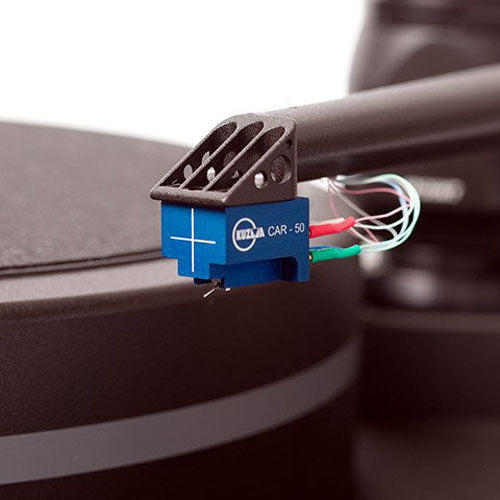
The Kuzma CAR 50 is a low-output moving-coil phono cartridge that pushes Kuzma’s CAR series into true reference territory, combining a sapphire cantilever, microridge stylus, and silver coils in a massively inert body for highly resolving yet natural analog playback.
Design and construction
The CAR 50 uses a heavily machined, 17 g aluminum body designed to maximize rigidity and drain vibrational energy efficiently into the tonearm for lower coloration and cleaner transient response.
Its generator employs 4N silver coil wire and samarium–cobalt magnetics, reflecting Kuzma’s focus on low-loss signal transfer and stable flux for wide bandwidth reproduction.
A sapphire cantilever carries a microridge stylus, a combination chosen for high stiffness, low mass, and superb groove contact, improving tracking of complex, high-frequency information.
Key specifications
-
Type: low-output moving coil, 0.3 mV at 3.54 cm/s (1 kHz)
-
Stylus/cantilever: microridge diamond on sapphire cantilever
-
Frequency response: 10 Hz – 45 kHz
-
Channel balance: <0.5 dB at 1 kHz
-
Channel separation: >30 dB at 1 kHz
-
Recommended tracking force: 2.0 g
-
Compliance: 10 x 10⁻⁶ cm/dyne
-
Trackability: >70 μm at 2.0 g
-
Internal impedance: 6 Ω; recommended load <100 Ω
System matching and setup
With its 10 cu compliance and 17 g body, the CAR 50 is optimized for medium-to-higher effective-mass tonearms such as Kuzma’s own 4Point and Stogi variants, where the mechanical interface supports exceptional control and energy transfer.
The 0.3 mV output and 6 Ω internal impedance make it a natural partner for high-quality MC phonostages offering adjustable loading in roughly the 80–1000 Ω range, with many reviewers settling around 100 Ω as a musically balanced setting.
Precise setup of VTA/SRA and azimuth is rewarded with tighter focus, improved soundstage depth, and reduced surface noise, thanks to the microridge stylus’s very fine contact patch.
Sonic character
Reviews describe the CAR 50 as tonally neutral yet richly saturated, with a solid, grounded midband, extended but unforced treble, and bass that combines weight with excellent pitch definition.
Imaging is noted as stable and three-dimensional, with a wide, coherent soundstage that preserves instrumental placement while avoiding exaggerated “hi-fi” edge or glare.
Its ability to resolve low-level detail and microdynamic nuance, while maintaining flow and timing, positions it as a cartridge for systems where long-term musical engagement matters as much as sheer resolution.
Kuzma’s CAR 50 is a low-output moving-coil cartridge with a 17 g body, sapphire cantilever, microridge stylus, and 0.3 mV output, optimized for heavy/medium–high-mass tonearms and MC stages with adjustable loading.
Technical specifications
-
Channel balance: <1 dB at 1 kHz (often quoted <0.5 dB in literature)
-
Recommended tracking force (VTF): 2.0 g (usable range approx. 1.8–2.0 g)
Recommended tonearm matching
-
Effective mass: the 17 g body with 10 cu compliance favors medium-to-heavy effective mass arms; Kuzma’s own 4Point and Stogi Reference/Ref 313 are ideal mechanical partners.
-
General guidance: avoid very low-mass arms; aim for arms in roughly 11–18 g effective mass, ensuring the counterweight can comfortably balance the 17 g cartridge without extreme extension.
-
Headshell and mounting: use a rigid headshell with minimal flex and torque mounting screws firmly but without overtightening to preserve the inert coupling the design relies on.
Phono stage loading and gain
-
Loading: factory documentation suggests >100 Ω, while practical use and reviews indicate best results typically between 80 and 1000 Ω, with many settling near 100 Ω as a musically balanced compromise between openness and control.
-
Gain: with 0.3 mV output, target total gain in the 60–66 dB region for most modern line stages; slightly higher (up to ~70 dB) can be beneficial in lower-sensitivity systems, provided noise remains low.
-
MC-only vs SUT: the cartridge works well straight into active MC inputs; if using a step-up transformer, choose a ratio that presents roughly 80–200 Ω to the cartridge, depending on tonal preference.
Alignment, VTF, and VTA/SRA
-
Tracking force: set initially at 2.0 g using a precise scale, then fine-tune within the 1.8–2.0 g window if needed for best tracking and tonal balance, avoiding going below the recommended band.
-
Alignment: use a high-precision protractor (Baerwald/Löfgren/Uni-DIN as preferred); the microridge profile is sensitive to setup, so spend extra time dialing in overhang and offset for minimal distortion and optimal imaging.
-
VTA/SRA: start with arm tube parallel to the record; small tail-up/tail-down adjustments can refine treble energy and focus because the microridge stylus is highly sensitive to SRA.
-
Azimuth: adjust for equal channel balance and maximal separation, ideally using test records or measurement tools, as the fine-line contact benefits noticeably from accurate azimuth.
Practical setup tips
-
Resonance target: with 10 cu compliance and a suitably massed arm, aim for an arm/cartridge resonance in the ~8–11 Hz range to avoid warps and audible bass modulation.
-
Handling: the substantial blocky body and bolt-on guard make fitting relatively safe, but the sapphire cantilever and microridge stylus are delicate—remove the guard only after the cartridge is roughly positioned and leads are attached.
-
Break-in: reviewers note performance stabilizing after tens of hours of play, with improved smoothness and microdynamics as the suspension settles.