


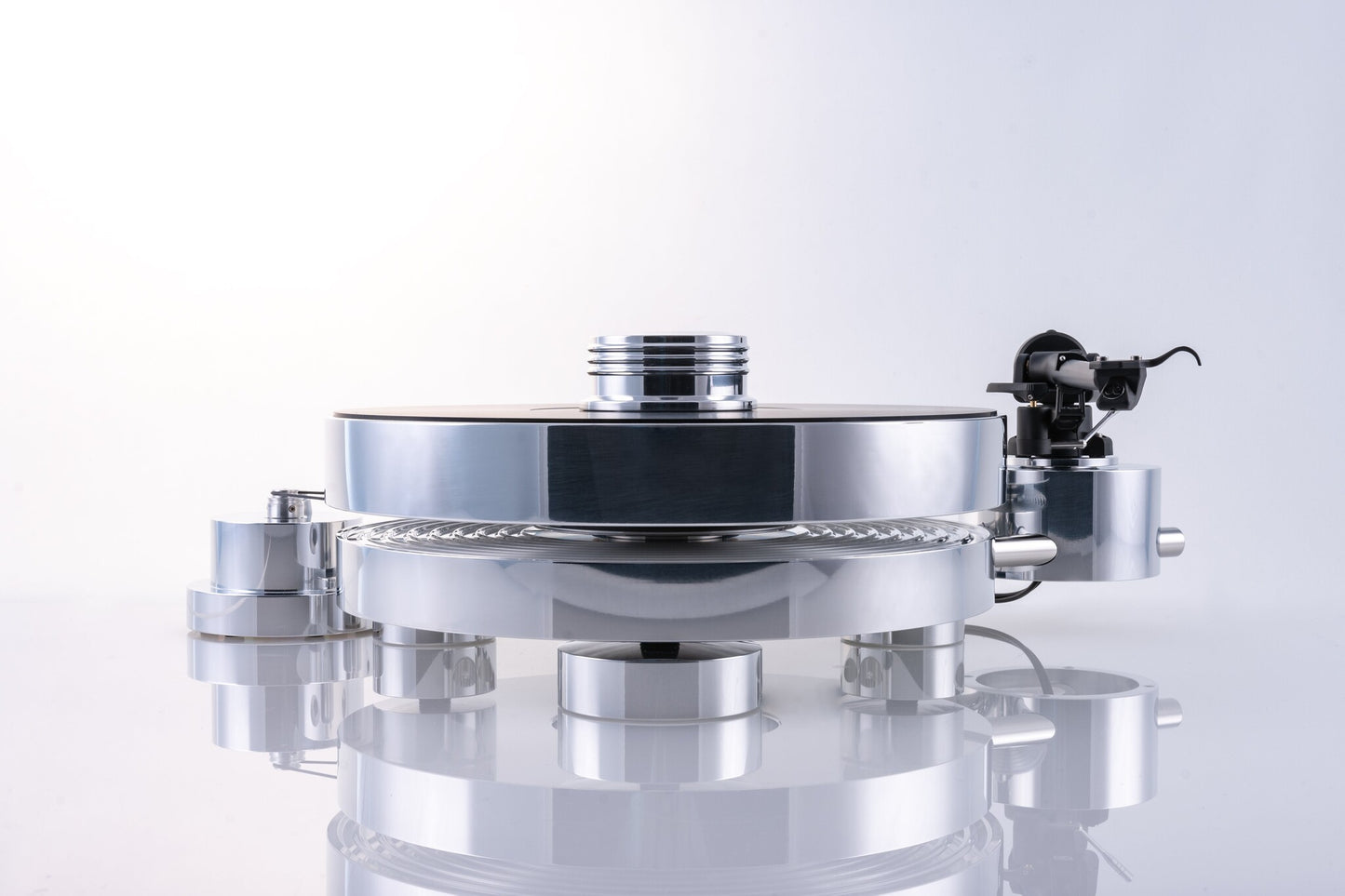
The Transrotor MAX is a belt-drive, high-mass turntable built as the entry point into the Transrotor range — and built to the same principles as the decks above it.
The name carries two meanings. Transrotor named it after a good friend, and it refers to maximum reduction: design is only good when nothing more can be left out. In practice that means an outboard motor with no contact with the deck beyond the drive belt, a stepless tonearm base, and provision for a second arm.
Where the MAX sits in the range is worth being precise about. Transrotor's Fat Bob and the models above it use the company's TMD magnetic bearing; Fat Bob S pairs that magnetic bearing with a 12 kg platter. The MAX is the conventional-bearing, 7 kg-platter deck below that tier. You get the mass-loaded architecture, the outboard motor and the modular arm mounting without the magnetic bearing.
This is not a turnkey deck. It's a platform.
Chassis & Isolation
The chassis is hand-polished solid aluminum — Transrotor's material of choice — giving both visual presence and mechanical stability. The construction echoes the larger Fat Bob designs.
The isolation approach is mass plus separation. The motor is outboard, with no contact with the platter apart from the drive belt, so motor vibration isn't transmitted into the chassis or the groove-tracing system. The rest is handled by mass: roughly 20 kg.
Platter & Bearing
The Max platter as aluminum/acrylic, weighing 7 kg. That mass provides the rotational inertia underpinning speed stability and a low noise floor.
It utilizes a precision inverted brass roller bearing fitted with a ceramic ball.
Drivetrain
A synchronous motor in a separate outboard pod drives the platter by belt. The MAX cannot be operated without an external power supply — this is why a supply is part of every configuration rather than an accessory.
The Konstant EINS is the entry point into Transrotor's external supplies, and is Transrotor's own recommendation for the Max. It ships as standard here. Speed selection between 33 and 45 rpm happens at the control unit, with separate fine adjustment for each speed.
Why an external supply matters mechanically: mains frequency typically drifts by around 5%, and with an unregulated supply that drift feeds straight into speed accuracy, because line frequency is the timing reference for the AC motor. The Konstant generates the required frequency itself, independent of AC line quality.
Compatibility & Setup
Cartridge matching follows from the arm rather than the deck.
The tonearm base is steplessly adjustable — this is horizontal position, allowing the base to be set for the arm's mounting distance. VTA and azimuth are functions of the arm you fit, not the deck.
The MAX has no built-in phono stage. A phono preamplifier appropriate to your cartridge is required.
Power Supply Specifications
| Spec | Figure |
|---|---|
| Output voltage | 2 × 18 V AC, two-phase |
| Output current (max) | 0.2 A |
| Speed correction range | ± 5% |
| Max voltage draw | 30 VA |
| Enclosure | 6 mm aluminium, 8 mm aluminium front plate |
| Dimensions (W × H × D) | 176 × 75 × 170 mm |
Common to the Konstant range.
Specifications
| Spec | Figure |
|---|---|
| Type | Belt drive, non-suspended, mass-loaded |
| Chassis | Hand-polished solid aluminum |
| Platter | Aluminum/acrylic, 7 kg |
| Motor | Synchronous, outboard pod, belt-coupled |
| Speeds | 33⅓ / 45 rpm, selected at the power supply, fine-adjustable |
| Arm base | Steplessly adjustable; accepts 9" and 12"; second base optional |
| Record weight | Aluminium, 370 g |
| Dimensions (W × D × H) | 44 × 33 × 17 cm |
| Weight | 20 kg |
| Country of manufacture | Germany (Bergisch Gladbach) |
Tonearm
The tonearm base is steplessly adjustable, and a second tonearm is possible. Both 9-inch and 12-inch arms are supported.
Armboards are machined to order for the mount you specify — Rega, Origin Live, SME, Sorane, Reed and others. This is the most consequential decision at purchase, because the board commits you to a geometry.
| Arm | Notes | Best for |
|---|---|---|
| Rega RB220 / RB330 | Direct mechanical compatibility. Available as a bundle on the Max. | A complete, low-friction package with good performance-per-dollar. Ideal if you want something ready to play that you can upgrade later with a better arm. |
| Transrotor TRA 9 | Mid-heavy 9" gimbal arm (~18 g effective mass), designed by Transrotor for use on their SME-type arm bases. | A fully "house-voiced" front end; matches well with most modern MC cartridges. If you spec the Max with an SME-pattern board, this is the most seamless premium upgrade. |
| Other SME-mount arms (e.g. SME M2-9, similar geometry designs) | Armboard ordered drilled for SME pattern. | Low- to medium-compliance MCs, which many Max owners favor. Makes sense if you already own an SME-mount arm or are committed to that ecosystem. |
| 12" Rega-pattern or SME-pattern arms | The steplessly adjustable base and optional second armboard allow 12" arms. Specifying the correct 12" drilling at order is key — the armboard is made to order. | Improved tracking geometry. Appealing if you run higher-end MCs, or want a dedicated mono or secondary cartridge. |
| Two-arm setups (9" + 9", or 9" + 12") | Requires the optional second base. | Mixing a quick-cue MM-friendly 9" arm with a heavier 12" MC arm — using the Max as a flexible cartridge platform. This plays directly into the Max's positioning as an upgradeable chassis rather than a fixed turnkey deck. |
Scroll table horizontally to see all columns.
Because the Max is drilled to order for a specific pattern, the "best" arm is often the one that matches the armboard you commit to at purchase. For future-proofing, a widely supported geometry — Rega-pattern or SME-pattern — gives the most cartridge and arm flexibility over time.
Need help with the configuration you want? Call Todd. He'll walk you through arm and armboard specs, including mounts not shown here, and make sure the drilling is right before the order goes to Germany.
Configure
Arm length
- 9"
- 12"
Power supply
- Konstant EINS "ONE"
- Konstant Studio
- Konstant M-1 Reference
Every MAX Includes
- Hand-polished aluminum chassis
- 7 kg aluminum/acrylic platter
- Steplessly adjustable arm base
- 370 g aluminum record weight
- Konstant EINS power supply
Upgrade Paths
- Higher-tier power supply
- Second arm base
- Longer or higher-end arm
Choosing Your Power Supply
All three supplies generate a regulated AC waveform for the synchronous motor and handle 33/45 rpm switching with fine adjustment. The differences are precision and noise, not tonal character.
| Supply | What you get | Who it's for |
|---|---|---|
| Konstant EINS | Transrotor's entry external supply, and their own recommendation for the Max. Clean, stable motor drive, quieter backgrounds, better bass definition, more stable imaging. | Fit-and-forget owners. Already a substantial step over an unregulated supply. |
| Konstant Studio | Improved synchronisation via a larger power transformer and a more complex circuit. Finer speed adjustment, lower noise, better long-term stability. | The sweet spot for heavier-platter decks. Gains are subtle — sustained notes lock in, imaging tightens. Worth it for solo piano, string quartets, sustained orchestral passages, vocals, acoustic jazz. |
| Konstant M-1 Reference | The Reference stage: more precise motor control still. M-1 is the single-motor version (M2 handles two motors, M3 three). Maximum precision and adjustability. | Reference systems only. If cartridge, phono stage, amplification, speakers and room can't reveal very small differences, its advantages are hard to appreciate. |
Scroll table horizontally to see all columns.
The honest framing: the M-1 is the most sophisticated single-motor controller Transrotor makes. Whether it's audible depends on your system. Recordings with long sustained notes — piano, pipe organ, chamber music, unaccompanied voice — are where speed precision is easiest to hear.
Build & Finish
Hand-polished aluminium chassis; aluminium/acrylic platter; aluminium record weight. Hand-built in Germany.
For buyers who want the same deck in black, Transrotor also builds the Max Nero — a POM chassis and 7 kg POM platter with stainless steel metal parts, sharing the Max's two-arm capability and upgrade paths.
The Konstant EINS is available in silver or black.
Why Transrotor
Transrotor was founded by Jochen Räke in Bergisch Gladbach, Germany, in 1971. The company still manufactures in Germany and describes itself as a family business. Turntables are the entire business — no arms, no cartridges — and Transrotor was first to market with magnetic drive.
On longevity: Transrotor states that a deck, once set up and adjusted, goes a very long time without further service, and that tables returning to the factory for overhaul are typically 15 to 30 years old.
FAQ
Can I use my existing tonearm?
If it's Rega-pattern, yes — specify the drilling at order. The armboard is machined to order, so the arm decision comes at purchase, not after.
Do I have to buy a power supply separately?
No. The Konstant EINS is included as standard. You can upgrade it at order or later.
Can I add a second arm later?
Yes — a second arm base is an option, and the deck supports 9" and 12" arms in combination.