


Call us to upgrade your DAC204 to the new Mk2 version!
Meet the new Weiss DAC204 Mk2, the compact Swiss “Swiss‑army‑knife” DAC that finally lets you stop worrying about your digital front end and just listen.
Why this DAC matters
The DAC204 Mk2 takes the proven 204 platform and upgrades the heart of the converter with an ES9028PRO-based DAC board and a near‑zero‑ohm output stage, delivering lower noise, tighter control, and even greater transparency than the original. Built by Weiss Engineering in Switzerland, it is voiced and engineered for both mastering rooms and serious listening rooms, so you get studio‑grade confidence at home.
Sound first: upgraded core and analog stage
At the core of the DAC204 Mk2 is the ES9028PRO chip implementation, chosen and tuned by Weiss for natural, low‑fatigue sound rather than hi‑fi fireworks. A near‑zero‑ohm output stage and dedicated linear regulators for all sensitive voltages keep “digital hash” and crosstalk out of the analog signal, so what you hear is effortlessly clean and dynamically alive. The result is an analog output that stays free of added grain and glare, even when you push levels or feed it complex, dense mixes.
Connection hub for real‑world systems
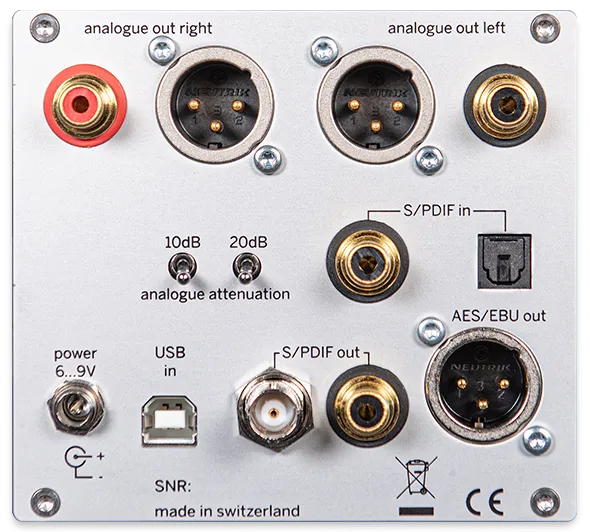
The DAC204 Mk2 is designed to sit at the center of your digital chain: it accepts USB plus two additional AES/EBU or S/PDIF inputs on Toslink or RCA, covering streamers, transports, computers, and pro interfaces at once. It locks to PCM from 44.1 kHz all the way up to 384 kHz and DSD64/128, so you can run everything from Red Book rips to modern hi‑res catalogs through a single box. On the output side you get balanced XLR and single‑ended RCA analog, plus AES/EBU digital outs on XLR, RCA, and BNC, letting the DAC204 Mk2 double as a high‑quality digital‑to‑digital format converter.
Effortless everyday operation
Front‑panel input selection makes it easy to flip between USB, Toslink, or RCA sources, which is ideal when you juggle a streamer, computer, and disc transport. Two front‑panel switches let you tailor DSD‑to‑PCM conversion, while rear‑panel level toggles let you optimize output for your preamp, integrated, or active monitors without sacrificing headroom. An external power supply is included, with internal linear regulation to keep the footprint small and the noise floor vanishingly low on any rack or desktop.
So, the DAC 204 MK2 is a compact, Swiss‑built, multi‑format DAC and format converter that combines studio‑grade conversion with plug‑and‑play flexibility. It’s the elegant solution for systems that need to integrate multiple digital sources, support both PCM and DSD, and possibly feed downstream digital gear, without compromising on the musicality and refinement Weiss is known for.
FLEXIBLE CONVERSION
Multi-format DAC and FORMAT CONVERTER
Dare we call the DAC204-MK2 a Swiss army knife? It is certainly the most versatile digital-to-analogue converter in Weiss Engineering’s product offering.
Use the DAC204-MK2 for easy switching between multiple digital sources — including a computer or mobile with USB out — and enjoy pristine, low-jitter conversion to analogue audio from the unit’s outputs. The MK2 version features a newly upgraded DAC board with an ES9028PRO chip and a near-zero-ohm output stage, further enhancing performance with difficult cables or low-impedance headphones. The unit can also convert DSD audio to PCM and offers a digital output in AES/EBU format.
Users highlight the advantages of pairing the DAC204 with the PSU102 for enhanced performance.
“Yesterday, I installed my new PSU102 to go with the DAC204, which I bought earlier this summer. Every music lover should have one. I didn´t believe that the 204 could be improved, but out of curiosity, I just had to give the 102 a try. The combination of these two products is absolutely marvelous.” C. Hedin
204-MK2 is a multi-format digital-to-analogue and digital-to-digital converter. Its many input and output options make it equally useful for use in a professional mixing or mastering studio as for an audiophile-grade listening room.
It now employs a redesigned DAC section: a new ES9028PRO chip featuring an advanced jitter-elimination circuit, plus an optimized output stage. The distortion figures and reconstruction filters have been fine-tuned by ear for an optimal sonic experience.
DIGITAL ACCEPTED HERE
The DAC204-MK2 accepts incoming digital audio streams straight from any USB-equipped computer, tablet, or mobile phone. It can also receive S/PDIF and AES/EBU audio via its S/PDIF or Toslink connectors.
OUTgoing AUDIO
The DAC204-MK2 converts the incoming digital streams to analogue audio, which simultaneously appears on its balanced XLR connectors and unbalanced RCA connectors.
It can also perform digital-to-digital conversion and output digital audio in AES/EBU or S/PDIF formats through the corresponding connectors and a BNC output connector.
Should the incoming audio be in DSD format, the DAC204-MK2 can convert that to PCM.
The DAC204 has a total of three digital stereo inputs:
- USB
- Two AES/EBU or S/PDIF on Toslink or RCA connectors.
Accepted formats: PCM 44.1kHz up to 384 kHz, DSD 64x / 128x.
Outputs:
- Line out unbalanced on RCA connector.
- Line out balanced on XLR connector
Front Panel:
- An Input Selector switch, to select the active input (USB, Toslink, or RCA).
- Two switches for DSD to PCM conversion settings.
- Power on/off switch.
Rear Panel:
- Digital inputs on USB, RCA, and Toslink connectors.
- Analog outputs on XLR and RCA connectors.
- Digital outputs (AES/EBU) on stereo XLR, RCA, and BNC connectors.
- Two toggle switches for output level setting.
- External power supply connector.
Measurements:
Depth: 16.5 cm / 6.5 inches
Width: 10.5 cm / 4.2 inches
Height: 9.5 cm / 3.8 inches
An external power supply is included with the unit. All sensitive voltages have their own linear regulators. The result is an analog output free of “digital noise” and channel crosstalk.