


Weiss HELIOS: Nothing Between You and the Music
The Weiss HELIOS is a professional-level, solid-state reference DAC with all of its analog processing done by Weiss's own discrete OP2-BP operational amplifiers. It originates in Weiss Engineering's line for professional mastering studios, where the world's top-tier engineers fine-tune the sound of the biggest artists on the planet and can't use anything but the best monitoring chain. The HELIOS keeps that quality level, with a design and features suited to high-end hi-fi, so you hear your music the way mastering engineers hear it in the studio.
Designed as a zero-compromise DAC, it also works as a preamp, a headphone amp and a network streamer (UPnP/DLNA, Roon Ready and Qobuz Connect), with Weiss's professional DSP built in. Choose Black or Silver.
Is It Right for You?
A Great Fit If You Want
- To hear your music as mastering engineers hear it, from a DAC that originates in Weiss's professional studio line.
- One component for streaming, conversion and volume control, feeding a power amp or active speakers directly.
- Level matching to your amplifier or headphones, with eight coarse output steps set separately for each.
- Room EQ, headphone EQ, crossfeed and other professional processing, switchable between speaker and headphone modes.
- Control from a touch screen, a remote or a web browser.
Consider Something Else If You Need
- A dedicated front headphone jack and a 4-pin XLR headphone socket: the DAC 502 Mk2, on the same platform. The HELIOS drives headphones from its XLR and RCA outputs instead.
- The same platform in a compact box just 18.8 cm wide: the DAC 501 Mk2.
- A simpler, far more affordable Weiss DAC without streaming, DSP or volume control: the DAC 204 Mk2.
- Digital outputs to feed another DAC or recorder: the HELIOS has analog outputs only (the DAC 204 Mk2 adds AES/EBU outputs).
- DSD256 or higher: DSD support stops at DSD128.
Purist Signal Path
Four Converters per Channel
The HELIOS uses an eight-channel 32-bit D/A converter chip with four conversion channels paralleled on each audio channel. An internal high-precision, low-jitter clock generator gives the converter section ultra-stable clocking.
The HELIOS shares its digital audio platform with its siblings, the DAC 501 Mk2 and DAC 502 Mk2, but has its own D/A converter and analog output section.
Weiss OP2-BP Discrete Op-Amps
All analog processing runs through Weiss's own discrete operational amplifier modules, the OP2-BP, which Weiss considers arguably the best audio op-amp currently available. The output stages are built on the same design, with no sound-degrading servo circuits.
Clean, Glitch-Free Power
A powerful non-switching power supply with two toroidal mains transformers, one for the digital circuits and one for the analog, feeds separate regulators for every sensitive voltage, split between the left and right channels. The result is an analog output free of "digital noise" and channel crosstalk.
The power switch drives a semiconductor relay that switches only at the mains zero crossing for glitch-free power-up, and the mains voltage is measured and selected automatically before the rest of the electronics powers on.
Dual-Frame Chassis
The housing uses a dual-frame scheme: a stainless steel internal frame inside a thick aluminum outer frame. It's a full-width component at 45 cm wide and just 6.6 cm tall.
High Connectivity
Five Digital Inputs and Streaming
| Ethernet | Roon Ready, UPnP/DLNA and Qobuz Connect (firmware 2.8.1) |
|---|---|
| USB | Computer audio |
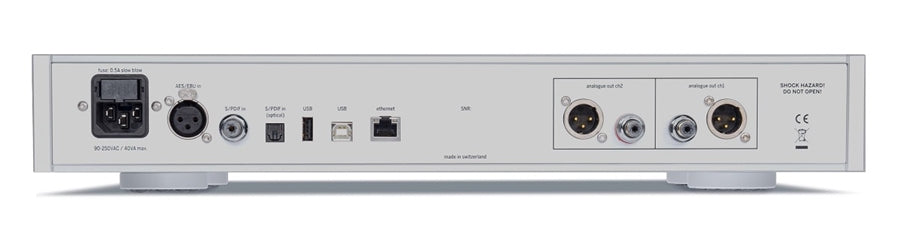
| XLR, RCA, Toslink | AES/EBU or S/PDIF from transports, streamers and pro gear |
| Formats | Up to PCM 384 kHz and DSD128, with the highest rates over USB and Ethernet; maximum input word length 24 bits |
The JPLAY iOS app brings Qobuz, Tidal and your local collection together in one library. Future formats can be added by software update, and a rear USB Type-A port serves various other applications.
Outputs
- Balanced line/headphone out on XLR
- Unbalanced line/headphone out on RCA
Both outputs can drive amplifier line inputs, or headphones directly or through a dedicated headphone amp. There is no separate headphone jack; ask Todd about the right cable for your headphones.
Professional Processing
The Algorithms Behind the Original Recordings
The built-in DSP is based on the same algorithms used in Weiss Engineering's professional audio tools, so you can adjust the sound with the professional-grade processing used to mix and master the original recordings. It switches between speaker and headphone modes, and each output keeps its own DSP settings. The room equalizer is set by hand rather than with a measurement microphone.
| Room Equalizer | Suppresses room modes for more accurate bass. |
|---|---|
| Creative Equalizer | Low, mid and high boost/cut, very useful for recordings that don't quite sound right. |
| Loudness Control | Equalization that follows your listening volume. |
| Constant Volume | Holds loudness constant across all tracks, useful for "party mode" when the volume control should stay untouched. |
| De-Essing | Automatically removes overly bright sibilance from voices, which can be more or less pronounced depending on your speakers and room. |
| Vinyl Emulation | The special sonic character of a record-player chain, including an emulation of the Stockfisch label's DMM-CD process. |
| Crosstalk Cancelling (XTC) | For speakers only. Dummy-head recordings normally need headphones, because each ear must hear only its own channel. XTC processing suppresses the sound reaching each ear from the opposite speaker, so dummy-head and live recordings sound as if you were in the space where they were made, with all the reverberation and 3D placement intact. |
| Headphone Equalizer | Adapts any headphone's frequency response to your ears. |
| Crossfeed | Gives headphone listening a speaker-like impression. |
Ease of Use
Three Ways to Control It
- Front panel: a touch-screen colour LCD and a rotary knob for settings and power.
- IR remote (included): input and output, volume, polarity, mute, DSP presets and power.
- Web browser: detailed DSP control and preset management, plus channel balance, output level and firmware updates.
Match Your Amp or Headphones
Besides the volume control, the analog output level can be set in eight coarse steps to suit the amplifier or headphones connected. Line and headphone levels are set independently. At the top step the balanced output reaches about 16 Vrms, enough to drive demanding headphones; start low.
HELIOS vs DAC 502 Mk2
Same Platform, Different Converter and Analog Section
Both are full-width Weiss network DACs with the same streaming, DSP and control. The HELIOS has its own D/A converter and analog section.
| Feature | HELIOS | DAC 502 Mk2 |
|---|---|---|
| D/A conversion | One 8-channel 32-bit chip, 4 paralleled per channel | Two 32-bit chips, 2 per channel |
| Analog stages | Weiss OP2-BP discrete op-amps | Weiss discrete electronics |
| Output level steps | 8 | 4 |
| Headphones | From the XLR and RCA outputs | Front 1/4" jack + rear 4-pin XLR |
| Streaming | Roon Ready, UPnP/DLNA, Qobuz Connect | Roon Ready, UPnP/DLNA, Qobuz Connect |
| Size (W × H × D) | 45 × 6.6 × 30 cm | 45 × 6.6 × 30 cm |
Choose the HELIOS If You
- Want the HELIOS converter and analog section: four paralleled conversion channels per audio channel and OP2-BP op-amps for all analog processing, where the DAC 502 Mk2 uses two conversion channels and its own discrete stages.
- Want more coarse output steps to match your amp or headphones: eight instead of four.
Choose the DAC 502 Mk2 If You
- Want to plug headphones into a dedicated 1/4" jack or 4-pin XLR socket without adapter cables.
- Want the same streaming, DSP and control for considerably less.
Specifications
Weiss HELIOS
| Type | Solid-state network DAC, preamp and headphone amp with discrete OP2-BP analog stages and DSP |
|---|---|
| D/A converter | Eight-channel 32-bit chip; four paralleled conversion channels per audio channel |
| Clock | Internal high-precision, low-jitter clock generator |
| Digital inputs | 5: AES/EBU or S/PDIF on XLR, RCA and Toslink; USB; Ethernet (UPnP/DLNA, Roon Ready, Qobuz Connect) |
| Formats | PCM 44.1 to 384 kHz; DSD64, DSD128; maximum input word length 24 bits |
| Analog outputs | Line/headphone out balanced on XLR, unbalanced on RCA; OP2-BP discrete output stages; no servo |
| Output level | Eight coarse steps, set independently for line and headphone use; about 16 Vrms balanced at the top step |
| Digital outputs | None |
| DSP | Room EQ, creative EQ, loudness, constant volume, de-essing, vinyl emulation, crosstalk cancelling, headphone EQ, crossfeed; speaker or headphone mode |
| Front panel | Rotary encoder (parameters and power), touch-screen colour LCD, IR receiver |
| Rear panel | XLR and RCA analog outputs; XLR, RCA, Toslink, USB and Ethernet inputs; USB Type-A port; mains inlet with fuses |
| Control | Touch screen, IR remote (included), web interface |
| Power supply | Non-switching, two toroidal transformers, separate left and right regulators, zero-crossing power relay, automatic mains voltage selection |
| Chassis | Stainless steel internal frame, thick aluminum outer frame |
| Finishes | Black or Silver |
| Dimensions (W × H × D) | 45 × 6.6 × 30 cm (17.7 × 2.6 × 11.8 in); 7.4 cm (2.9 in) high with feet |
| Weight | 9.4 kg (20.7 lb) |
| Remote (W × H × D) | 4.5 × 16.6 × 2.1 cm |