


ATC SCM200ASLT: Twin 12-Inch Active Tower
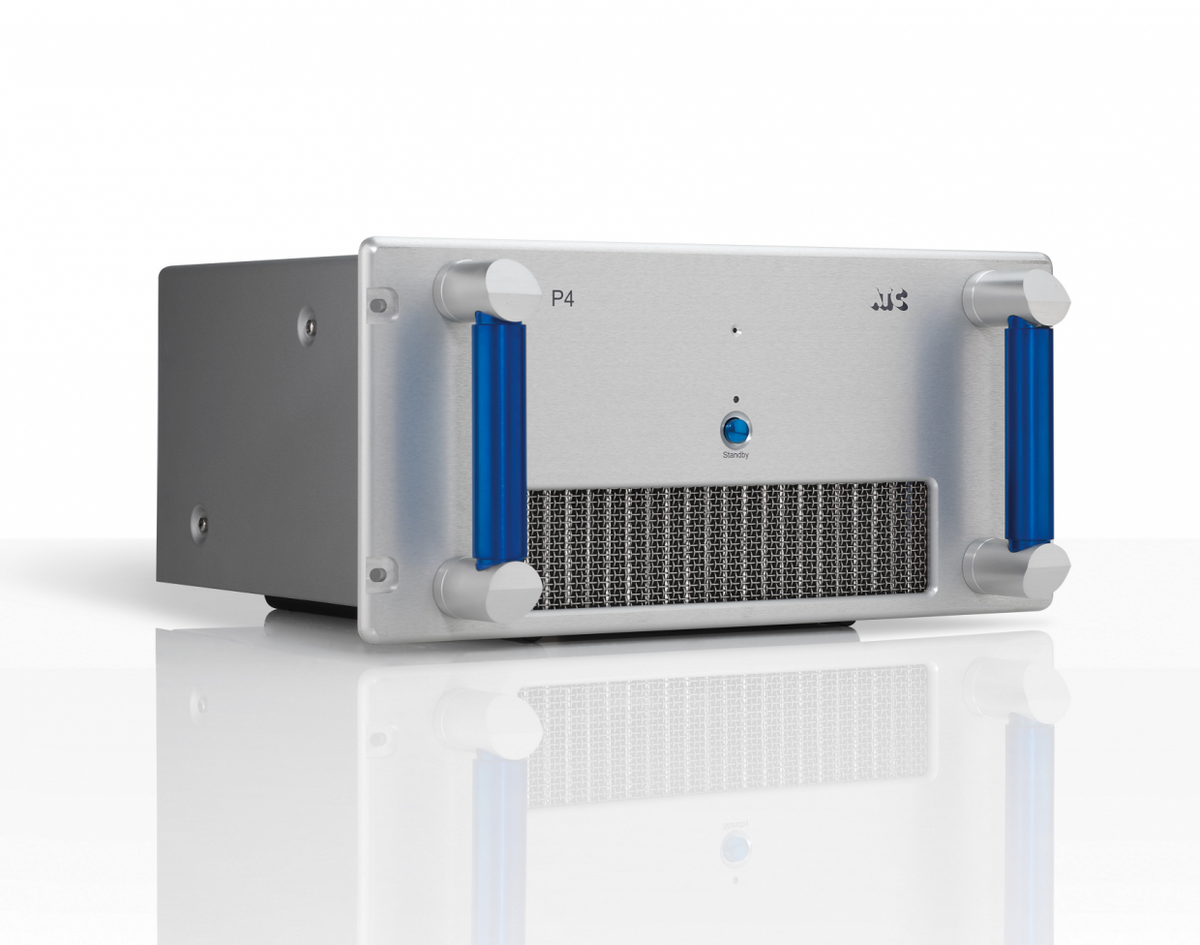
The ATC SCM200ASLT is a three-way active floorstanding loudspeaker from ATC's Tower series, built around twin 12-inch Super Linear bass drivers, ATC's 75 mm Super Dome midrange and a 25 mm dual-suspension S-Spec soft-dome tweeter. Its cabinet is just 398 mm wide. Each speaker is driven by its own ATC P4: a rack-mount, four-channel Class AB amplifier with built-in active crossovers that sends 275 W to each bass driver, 200 W to the midrange and 100 W to the tweeter, 850 W per speaker.
You add a preamp or a source with a variable XLR output. There's no power amplifier or speaker crossover to buy: the two P4 amplifiers handle both. Prefer to use your own power amplifier? See the passive version, the ATC SCM200PSLT.
TTVJ is an authorized ATC dealer. Every unit we sell is brand new, and Todd's advice comes from setting up ATC loudspeakers in real listening rooms.
Is It Right for You?
A Great Fit If You Want
- A complete active system: speakers, amplifiers and crossovers matched by ATC.
- An active crossover that splits the signal before the amplifiers, so each of the four drivers per speaker has its own amplifier channel with no passive crossover in between.
- Twin 12-inch bass drivers in a cabinet only 398 mm wide, driven by 850 W per speaker.
- High output: 118 dB continuous at 1 m.
- Amplifiers that can sit in a rack or on shelving away from the speakers.
Consider Something Else If You Need
- To use your own power amplifier: the passive SCM200PSLT (see the comparison below).
- Bass to 25 Hz and more output: the SCM300ASLT, with twin 15-inch drivers and the same P4 system.
- Amplifiers built into the speaker, with no rack or shelf space for two 5U amplifiers: the SCM150A Classic.
Design
Twin 12 in SL Bass
Two full-spec 314 mm bass drivers with ATC's Super Linear (SL) magnet technology, each on its own 275 W amplifier channel. Free-standing, the response reaches 32 Hz (−6 dB).
75 mm Super Dome Mid
ATC's soft-dome midrange covers 380 Hz to 3.5 kHz on its own 200 W channel, the range where voices sit.
25 mm S-Spec Tweeter
A dual-suspension S-Spec soft-dome tweeter takes over above 3.5 kHz on a 100 W channel, with thermal protection.
One ATC P4 Amplifier Per Speaker
Each speaker comes with its own ATC P4, a four-way mono-block amplifier made only for ATC active systems. It holds the three-way active crossover (380 Hz and 3.5 kHz, 4th order) and four Class AB amplifiers built on ATC's grounded-source design: 275 W for each bass driver, 200 W for the midrange and 100 W for the tweeter. The P4 is a 19-inch, 5U rack unit weighing 35.8 kg, and it connects to its speaker with one 8-way cable. Full P4 specifications are listed under Specifications.
SCM200ASLT vs SCM200PSLT
Active or Passive: The Differences
The SCM200ASLT and the passive SCM200PSLT share the same cabinet, drivers and finishes. They differ in how they are driven:
| Difference | SCM200ASLT | SCM200PSLT |
|---|---|---|
| Amplification | One ATC P4 per speaker, 850 W (included) | Your own power amplifier |
| Crossover | Active, inside the P4, 4th order | Passive, inside the speaker, 2nd order |
| Connection | Balanced XLR from a preamp, 2 V | Tri-wire binding posts |
| Sensitivity / impedance | n/a | 91 dB/W/m, 8 Ω |
| Max. SPL (1 m) | 118 dB | 117 dB |
| What you connect | A preamp or source with a variable XLR output | An integrated amplifier, or a preamp and power amplifier |
| Space and power | Two 5U P4 amplifiers (included), each with its own mains connection | Your amplifier (not included) |
Choose the SCM200ASLT If You
- Want a complete system without buying a power amplifier: ATC's P4 amplifiers and active crossovers are included.
- Want each driver on its own amplifier channel, with no passive crossover between amplifier and driver.
Choose the SCM200PSLT If You
- Already own, or want to choose, your own power amplifier.
- Want to use an integrated amplifier, or prefer not to house two 5U rack amplifiers.
SCM200ASLT vs Other ATC Active Models
SCM200ASLT, SCM300ASLT and SCM150A Classic
| Feature | SCM200ASLT | SCM300ASLT | SCM150A Classic |
|---|---|---|---|
| Format | Tower | Tower | Classic, on stand |
| Bass drivers | 2 × 314 mm SL | 2 × 375 mm SL | 1 × 375 mm SL |
| Mid / HF | 75 mm Super Dome / 25 mm | 75 mm Super Dome / 25 mm | 75 mm / 25 mm |
| Crossover points | 380 Hz, 3.5 kHz | 380 Hz, 3.5 kHz | 380 Hz, 3.5 kHz |
| Amplification | External P4, 850 W | External P4, 850 W | Built in, 350 W |
| Bass (−6 dB) | 32 Hz | 25 Hz | 25 Hz |
| Linearity (±2 dB) | 60 Hz to 12 kHz | 50 Hz to 12 kHz | 60 Hz to 17 kHz |
| Max. SPL (1 m) | 118 dB | 121 dB | 117 dB |
| Size (H × W × D) | 1586 × 398 × 535 mm | 1500 × 500 × 580 mm | 884 × 498 × 568 mm, plus 200 mm stand |
| Input sensitivity | 2 V | 2 V | 1 V, with rear trim |
Choose the SCM200ASLT If You
- Need a narrow speaker: 398 mm wide, versus about 500 mm for the other two.
Choose the SCM300ASLT If You
- Want deeper bass: 25 Hz versus 32 Hz.
- Need more output: 121 dB versus 118 dB.
Choose the SCM150A Classic If You
- Want the amplifiers inside the speaker, with no rack or speaker-to-amp cables to plan.
- Want bass to 25 Hz from a shorter speaker on a stand.
Not Sure Which to Choose?
The SCM200ASLT or the passive SCM200PSLT? Or the SCM300ASLT or SCM150A Classic? Todd can talk it through with you.
Available Finishes
Choose Your Finish
| Standard veneers | Cherry, Walnut, Oak, Black Ash |
|---|---|
| Standard paints | Satin Black, Satin White |
| Premium veneers (up-charge) | Rosewood, European Crown Cut Walnut, Pippy Oak, Burr Magnolia, Burr Poplar |
| High gloss (up-charge) | Clear High Gloss Veneer, Piano Black, Piano White |
Planning and Setup
1Step 1: Plan the Space
- Each speaker is 1586 mm tall, 398 mm wide and 535 mm deep.
- Each P4 goes in a 19-inch rack (5U) or free-standing on sturdy shelving. Air enters at the back and leaves at the front, so never block either vent or enclose the amplifier.
- The P4's fans start when its heatsink reaches about 30 °C and keep running until it cools to about 20 °C, even in standby. Keep that in mind when choosing where it sits.
- The cable from each P4 to its speaker is 5 m as standard. 10 m cables are available, and runs up to 20 m are possible by splicing 4 mm² cable onto a 10 m cable.
- Each P4 needs an earthed mains connection.
2Step 2: Unpack and Position
- These are large, heavy speakers: unpack them with a second person, in a large open space near their final position.
- Keep the speakers away from corners and walls to reduce low-frequency problems.
- Carpets, curtains and soft furnishings help control reflections in the midrange and treble.
Todd can help you work out positions, cable runs and where the amplifiers should go before delivery.
3Step 3: Connect
- P4 to speaker: one 8-way cable per speaker.
- Source to P4: a balanced XLR cable from your preamp or source to each P4 (pin 1 screen, pin 2 hot, pin 3 return). Plan on supplying your own XLR signal cables; Todd can confirm what's in the box.
- Level: volume is set at your preamp or source.
- Unbalanced sources: use an XLR-to-RCA cable. If you hear hum, disconnect the screen at one end.
- Mains: use the supplied lead and check the voltage shown on the P4's panel matches your supply.
4Step 4: Power On
- Switch on each P4 separately, one after the other, to limit the inrush current.
- Set the rear isolation switch to ON, then press the front standby button once.
- The P4 runs its self-checks: the indicator changes from green to orange, blue flashes, red shows briefly as the mute releases, then the indicator settles on steady blue. It's ready to play. Start with the volume low and raise it gradually.
- A short sound from the speakers when power is applied or removed is normal and harmless.
5Step 5: Everyday Use
| Standby | Press the standby button: the blue light goes out and only green remains. |
|---|---|
| Occasional red during loud playback | The P4 is briefly reducing gain to protect the drivers. Turn the level down a little. |
| Steady orange | A fault or power-up failure has shut the amplifier down. Press standby to restart; after overheating, let it cool first. If there's no response, check the rear fuse; if a replacement fuse also fails, call Todd. |
| Custom installation | A 5-pin remote interface on the P4 provides standby control and status outputs for a control system. |
Specifications
ATC SCM200ASLT
| Type | 3-way active floorstanding loudspeaker, four amplifier channels per speaker |
|---|---|
| Drivers | HF 25 mm dual-suspension S-Spec soft dome; Mid 75 mm Super Dome; LF 2 × 314 mm Super Linear |
| Amplitude linearity (±2 dB) | 60 Hz to 12 kHz |
| Cut-off (−6 dB, free-standing) | 32 Hz and 20 kHz |
| Dispersion | ±80° horizontal, ±10° vertical, coherent |
| Max. continuous SPL (1 m) | 118 dB |
| Crossover | 380 Hz and 3.5 kHz; 4th-order active, critically damped |
| Input | Female XLR, balanced >10 kΩ, 2 V sensitivity |
| Amplifier output | Bass 275 + 275 W, mid 200 W, high 100 W per speaker (ATC P4) |
| Overload protection | Active FET momentary gain reduction plus thermal tweeter protection |
| Speaker cable | 8-way cable per speaker, 5 m standard; 10 m available |
| Dimensions (H × W × D) | 1586 × 398 × 535 mm (62.44 × 15.67 × 21.06 in) |
| Weight | TBA |
| Warranty | 6 years |
ATC P4 Amplifier (One Per Speaker)
| Output per channel | Bass 1: 275 W into 8 Ω; Bass 2: 275 W into 8 Ω; Mid: 200 W into 16 Ω; HF: 100 W into 6 Ω (850 W total) |
|---|---|
| Crossover | Active, 380 Hz and 3.5 kHz, 4th order with phase correction |
| Input | Balanced XLR, 2 V sensitivity, >10 kΩ |
| Frequency response | 5 Hz to 20 kHz, ±0.1 dB |
| Signal-to-noise / crosstalk | Better than 105 dB / better than 90 dB |
| Protection | Active FET momentary gain reduction (soft limiting) |
| Cooling | Three fans |
| Mains | 100, 115 or 230 V, 50/60 Hz, set at the factory for your region |
| Power consumption | 150 VA in standby, 1200 VA maximum |
| Size | 19-inch rack mount, 5U (222 mm) high; 538 mm overall depth including front and rear handles |
| Weight | 35.8 kg (78.8 lb) |
Order Your ATC SCM200ASLT
As an authorized ATC dealer, TTVJ handles your order personally, from confirming the configuration to delivery. Reach Todd by phone or message to:
- Confirm current pricing and availability
- Discuss a trade-in of your current speakers
- Ask about financing and shipping